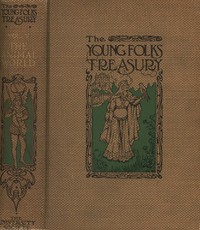
The Animal World, A Book of Natural History Young Folks' Treasury (Volume V) — Reading Companion

(0 User reviews)   255
In Category - Animals
Wood, Theodore, 1862-1923, Ingersoll, Ernest, 1852-1946 [Editor] Project Gutenberg 2013 Not confirmed
Animals -- Juvenile literature Readers of public-domain and historical texts
Project Gutenberg digital edition en

Edition facts

Words 189,705
Reading time 825 min
Text sections 22

The catalog record for The Animal World, A Book of Natural History Young Folks' Treasury (Volume V) — Reading Companion provides practical reading context through 189,705 words, 13 hr 45 min estimated reading time, and 22 detected text sections.

The text analysis averages about 25.8 words per sentence, while the detected sections provide another way to judge how the source is divided.

Project Gutenberg metadata also associates the work with “Animals -- Juvenile literature,” connecting these edition facts with the source record’s subject description.

An editorial note on the authorial choices in Theodore Wood's natural history volume, focusing on diction, dialogue, and description in the crow family section.
Share
Editorial Edition Score 4.9/5

Calculated from edition completeness, EPUB availability, text structure and catalogue metadata. Not a user rating.

How this score is calculated
  • Description quality20 pts
  • Title & short description10 pts
  • Source metadata20 pts
  • Text length15 pts
  • Chapters / structure15 pts
  • EPUB file integrity20 pts

Total of 100 points, scaled to a 2.5-5.0 range. Editions with an empty description or a missing EPUB file are not scored.

Edition quality

Read the Text

kespeare was wrong in thinking that moles are blind, he was quite right in reminding us that they have very sharp ears.

The gardener, of course, looks upon the mole as a foe; and so it is when it drives its tunnels under our lawns, and throws up great heaps of earth on the surface of the grass. And the farmer regards it as a foe too, and kills it whenever he has an opportunity. But perhaps the farmer may not know what a busy little animal the mole is, and what thousands and thousands of mischievous grubs it devours. There are wireworms, which nibble away at the roots of plants till they kill them, and then move on to destroy other plants in the same way. There are "leather-jackets," or daddy-long-legs grubs, which feed upon the roots of grass, and sometimes ruin all the turf in a meadow. There are also the great fat white grubs of beetles, which are worse, perhaps, than either; and many others as well. Now the mole is always preying upon these. It eats them in hundreds every day of its life. And just think of all the mischief that they would have done if they had been allowed to live! No doubt it is annoying to the farmer to have molehills among his hay, which blunt the knives of the reaping-machines, and prevent them from cutting properly. But even that is better than having no hay to cut; and there would be none if all these mischievous grubs were allowed to live.

But there is another way as well in which the mole is useful; for the earth which it digs up from down below, and throws up in heaps on the surface of the ground, serves for what the farmer calls a top-dressing. After a time, you see, the nourishment in the soil at the surface is sucked out of it by the roots of the grass. If it were in a garden, the farmer could dig it. If it were in a corn-field, or a turnip-field, he could plow it. But in a meadow, he can do neither, without destroying the pasture. So he applies a top-dressing. He gets some good, rich earth from elsewhere, and spreads it over the surface; and this earth works down to the grass-roots, and gives them just the nourishment they require.

Now this is exactly what the mole is always doing. The earth which it throws up is fresh, rich earth from down below, which the roots have not reached. It is just what the failing grass requires. And if the farmer rakes the molehills down, so as to spread this earth evenly over the surface of the field, he finds that it forms a top-dressing quite as good as any he could apply himself. So instead of looking upon the mole as one of his enemies, he ought to include it in the list of his laborers.

THE LITTLE WELL-DIGGER

Another thing that we must tell you about the mole is the way in which it obtains water. It is a very thirsty animal, and constantly requires to drink. At the same time, it cannot leave its burrow half a dozen times a day, in order to visit a stream or a pond, for it would almost certainly be killed by one of its many enemies. So it actually digs little wells of its own, always doing so in the dampest parts of its tunnels, where they fill up almost immediately. And when it wants to drink it just goes off to the nearest of these wells and satisfies its thirst.

But the most wonderful thing that the mole does is to make what we call a fortress, surrounding the chamber in which it sleeps. This fortress is situated either in a natural mound of earth, or else beneath the spreading roots of a tree or a large bush; and it is made in this way: First the mole digs a short circular gallery. A little way under this it digs another, rather larger in diameter, and connects the two by means of five short passages. In the middle of the mound, and about half-way between the two galleries, it scoops out a large round hole, from which three passages run to the lower gallery. This is the mole's bedroom, and it communicates with the main burrow by a tunnel which dips under the lower gallery. Finally, a number of runs branch out from the lower gallery in all directions.

Theodore Wood's account of the crow family in The Animal World reveals a distinctive authorial voice that blends precise observation with anecdotal charm. In describing the rook, Wood notes that young birds are not allowed to build outside the rookery, their nest being 'at once pulled to pieces by the older ones.' This detail, drawn from natural history, is presented with a tone that suggests both authority and a hint of moral judgment. The jackdaw anecdote—where a tame bird calls 'Gee up!' to a butcher's horse—showcases Wood's willingness to include humorous, almost anthropomorphic vignettes. Such choices make the text engaging for young readers while maintaining scientific credibility.

Diction and the Personification of Birds

Wood frequently employs personifying language that attributes human-like intentions to birds. The jay is described as 'shy' and 'terrified,' while the magpie is 'mischievous out of doors' and 'mischievous indoors.' This diction creates relatable characters rather than mere biological subjects. The rook's social structure is framed in terms of 'crime' and 'punishment,' with older birds enforcing nest-building rules. Such word choices reflect a Victorian-era natural history tradition that moralizes animal behavior, yet Wood avoids overt sentimentality. Instead, he uses these terms to make the birds' actions vivid and memorable, as when the jackdaw 'plays very amusing tricks.' The language is accessible but never condescending, balancing factual reporting with narrative flair.

Dialogue and Sound in the Text

Wood incorporates direct speech and sound descriptions to animate his subjects. The jackdaw's command 'Gee up!' is the only instance of spoken dialogue in the excerpts, and it serves as a punchline to a carefully constructed anecdote. Elsewhere, Wood describes the jay's 'terrified squall' that can be heard from 'nearly half a mile away,' emphasizing auditory detail. The magpie's 'curious dipping flight' is noted visually, but sound is a recurring motif: the rook's calls, the jackdaw's chatter, and the jay's alarm. These choices ground the text in sensory experience, helping young readers imagine the birds in their habitats. Wood's use of dialogue is sparing but effective, breaking the expository flow with a moment of direct character.

Structure and the Use of Anecdote

Each bird entry follows a consistent structure: general description, behavior, and often a specific anecdote. The rook entry begins with social habits, then moves to economic value. The jackdaw entry shifts from nesting sites to a pet story. The jay entry opens with a rhetorical question ('What a beautiful bird the jay is!') before detailing its shyness and diet. The magpie entry concludes with a summary of its character. This pattern—moving from the general to the particular—allows Wood to embed memorable stories within a factual framework. The anecdotes are not mere digressions; they illustrate key traits, such as the jackdaw's attraction to shiny objects or the jay's egg-stealing. By alternating between exposition and narrative, Wood maintains reader interest while conveying information.

Recurring Details and Authorial Perspective

Several details recur across the crow family entries, revealing Wood's authorial priorities. He consistently notes the birds' economic impact on farming: rooks 'devour enormous quantities of mischievous grubs,' jays eat 'caterpillars, moths, beetles,' and magpies are 'mischievous' but not condemned. Wood also emphasizes the birds' intelligence and adaptability, as seen in the jackdaw's talking ability and the magpie's hiding behavior. The physical descriptions are precise but brief, focusing on plumage and crests. Wood's perspective is that of a naturalist who values observation over theory; he does not speculate on evolution or classification. Instead, he presents each bird as an individual with habits worth knowing. This approach makes the text feel personal, as if Wood is sharing his own encounters with the reader.

Readers approaching The Animal World will find that Wood's authorial choices—his personifying diction, use of anecdote, and attention to sound—transform a reference work into a series of vivid portraits. The crow family section exemplifies his method: each bird is given a distinct personality through carefully selected details. By noting these patterns, readers can better appreciate how Wood balances scientific accuracy with narrative appeal, making natural history accessible without sacrificing depth.

Reading how Theodore Wood chose plain words for the crows, I remembered my father’s quiet voice naming the magpies in our orchard—no fuss, just facts. The same calm steadiness lives in The winners in life's race — Edition Insights, where each small victory felt less like cheering and more like sitting beside the finish line, breathing. That book taught me patience with endings; this one, patience with beginnings.

There are no reviews for this eBook.

0
0 out of 5 (0 User reviews )

Add a Review

Your Rating *
There are no comments for this eBook.

Reader reflection

Record your reading impressions

A brief reflection can help important ideas stay with you longer.

Your progress 0 / 10
1

How far have you progressed with this book?

2

How much did you enjoy the reading experience?

3

Would you pass this book on to a friend?

4

What was the reading difficulty like?

Related eBooks