About 431 minutes
The Life of the Fly; With Which are Interspersed Some Chapters of Autobiography — Context and Discussion
Animals
98,916 recorded words. 3 minutes difference from this book's estimate.
View Gutenberg source #3422
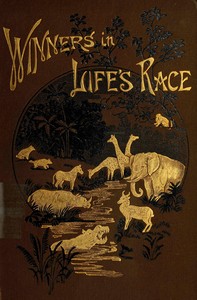
The source record for The winners in life's race — Edition Insights measures this digital text at 99,811 words, 7 hr 14 min estimated reading time, and 25 detected text sections.
The text analysis averages about 29.5 words per sentence, while the detected sections provide another way to judge how the source is divided.
Project Gutenberg metadata also associates the work with “Animals -- Juvenile literature,” connecting these edition facts with the source record’s subject description.
Explore this collection
These alternatives are selected using recorded categories and estimated reading time.
About 431 minutes
Animals
98,916 recorded words. 3 minutes difference from this book's estimate.
View Gutenberg source #3422About 424 minutes
Animals
97,298 recorded words. 10 minutes difference from this book's estimate.
View Gutenberg source #17748About 423 minutes
Animals
97,064 recorded words. 11 minutes difference from this book's estimate.
View Gutenberg source #67073Search stored excerpts and compare books → Choose by your preferences →
Choices use stored catalog measurements. Estimates vary with reading speed. A shared category is a catalog label, not a claim that two books have the same argument or literary quality.
Search reads excerpt text stored with this catalog and links to its associated Gutenberg record. The connection is stored in the site database; this tool does not recheck that every excerpt is word-for-word identical to that external record. Excerpt search does not cover every chapter and does not verify historical publication dates.
Catalog snapshot checked: 2026-09-26. Coverage: 99 public books, 99 available source excerpts.
Calculated from edition completeness, EPUB availability, text structure and catalogue metadata. Not a user rating.
Total of 100 points, scaled to a 2.5-5.0 range. Editions with an empty description or a missing EPUB file are not scored.
Public-domain source text
The source text is kept in the dedicated reader, separate from this catalogue record and its commentary.
Arabella B. Buckley opens The Winners in Life's Race by framing the vertebrate animals as a "great backboned family" whose history must be traced through geological time. Unlike her earlier book on invertebrates, she argues that understanding vertebrates requires delving into the past, because their groups are "so closely interlinked one with another and yet so sharply separated." The preface establishes a clear pedagogical aim: to describe "graphically the early history of the backboned animals, so far as it is yet known to us," while focusing on modern types that best illustrate present divisions. Buckley intends to follow "the tide of life" rather than multiply species descriptions.
Buckley consistently pairs anatomical description with behavioral and ecological reasoning. In discussing South American edentates (sloths, ant-bears, armadillos), she notes their "variability of structure which always points to a low order of animals"—a claim rooted in the irregular number of neck joints in sloths and the reptilian bony plates of armadillos. She then asks how such seemingly ill-equipped creatures survived alongside predators like jaguars and pumas. Her answer: concealment. The aardvark, for instance, "lives almost entirely underground, only venturing out at night" and never far from its hole. This pattern of posing a structural puzzle and resolving it with behavioral evidence recurs throughout the excerpts.
A central argument in the excerpts is that geographic isolation allowed ancient, low-competition groups to persist. Buckley traces how marsupials and edentates, once widespread in Europe, were pushed to the margins—Australia for marsupials, South America and Africa for edentates—by more advanced mammals. She writes that creatures cut off "from the crowded world" could "live on and fill the land." The description of South America as a refuge for "large creepers and burrowers" is supported by fossil evidence: gigantic sloth-like animals and armadillo-like creatures found there. Buckley also invokes the Sahara's former sea barrier to explain why African pangolins and aardvarks survived while their northern relatives did not.
Buckley repeatedly turns to fossils to reconstruct past life, but she does so cautiously. She mentions opossums living in Europe and "strange animals, with imperfect rootless teeth" in France and Greece, then later finds of "huge imperfect-toothed creatures" on the Pacific coast of North America. In South America, "whole skeletons of gigantic sloth-like animals the size of elephants" are cited. These fossils are used not as mere curiosities but as evidence for migration and extinction patterns. Buckley's method is to "picture to ourselves" how these animals lived, based on their skeletal features—bent claws, weak teeth—and then infer why they were outcompeted. The excerpts show a careful balance between storytelling and scientific restraint.
Readers should note that Buckley's book is structured as a series of type-studies rather than a continuous narrative. The excerpts reveal a strong emphasis on the interplay between anatomy, behavior, and geography, but the full work likely extends these patterns across all vertebrate classes. For those interested in 19th-century popular science, this volume offers a window into how evolutionary ideas were communicated to a young audience before the modern synthesis.
Reading Buckley’s patient tracing of ancient creatures into their slow, quiet niches, I found myself thinking back to a different kind of inheritance—the gentle curiosity in Little Frank and other tales — A Closer Reading. Both books leave room for wonder without forcing an ending, much like the fossil gaps she never pretends to fill. A modest companionship, that.
Your answers remain private and are stored only in this browser.