About 196 minutes
Followers of the Trail — Text and Context
Animals
44,916 recorded words. 7 minutes difference from this book's estimate.
View Gutenberg source #22311
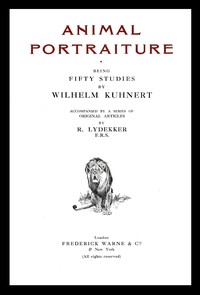
For Animal portraiture — Key Ideas to Explore, the stored edition analysis reports 46,553 words, 3 hr 23 min estimated reading time, and 55 detected text sections.
The text analysis averages about 29.1 words per sentence, while the detected sections provide another way to judge how the source is divided.
Project Gutenberg metadata also associates the work with “Animals -- Pictorial works,” connecting these edition facts with the source record’s subject description.
Explore this collection
These alternatives are selected using recorded categories and estimated reading time.
About 196 minutes
Animals
44,916 recorded words. 7 minutes difference from this book's estimate.
View Gutenberg source #22311About 211 minutes
Animals
48,436 recorded words. 8 minutes difference from this book's estimate.
View Gutenberg source #35513About 186 minutes
Animals
42,552 recorded words. 17 minutes difference from this book's estimate.
View Gutenberg source #55097Search stored excerpts and compare books → Choose by your preferences →
Choices use stored catalog measurements. Estimates vary with reading speed. A shared category is a catalog label, not a claim that two books have the same argument or literary quality.
Search reads excerpt text stored with this catalog and links to its associated Gutenberg record. The connection is stored in the site database; this tool does not recheck that every excerpt is word-for-word identical to that external record. Excerpt search does not cover every chapter and does not verify historical publication dates.
Catalog snapshot checked: 2026-09-26. Coverage: 99 public books, 99 available source excerpts.
Calculated from edition completeness, EPUB availability, text structure and catalogue metadata. Not a user rating.
Total of 100 points, scaled to a 2.5-5.0 range. Editions with an empty description or a missing EPUB file are not scored.
Public-domain source text
The source text is kept in the dedicated reader, separate from this catalogue record and its commentary.
Wilhelm Kuhnert's fifty animal studies in this volume are accompanied by Richard Lydekker's descriptive articles, each focusing on a single species. The foreword compares Kuhnert to Frans Hals, praising his "vigorous realism" and ability to render animals "set in its local atmosphere." Lydekker's prose complements the plates with natural history details, such as the marten's preference for "woods where dead tree-trunks lie rotting on the ground" and the leopard's distinctive coat pattern. The collaboration between artist and writer creates a dual portrait—visual and textual—of each creature.
The foreword emphasizes Kuhnert's skill as a colourist and draughtsman, noting that "there is none with a more masterly touch or more unmistakable individuality." His studies are praised for blending the animal with its surroundings, with landscapes "painted on the spot." The text claims that Kuhnert "has, as it were, got inside the very skin of African life," suggesting an immersive method. His background as a portrait painter of humans is said to have informed his animal work, allowing him to capture character and expression. The fifty studies included are described as "characteristic," implying they represent his typical style and range.
Lydekker's articles provide factual accounts of each species, often including details of behaviour, habitat, and distribution. For example, the marten entry notes that martens "are essentially forest-animals, which prefer evergreen trees" and are "deadly foes to hares, rabbits, pheasants, and partridges." He also discusses taxonomic questions, such as whether the marten and sable are distinct species or "geographical races." The writing is precise and observational, avoiding anthropomorphism. Lydekker occasionally includes anecdotal information, such as the marten's persistence in following prey "even in deep snow," but maintains a scientific tone throughout.
The volume's structure pairs each plate with a corresponding article, inviting comparison between visual and verbal representation. The foreword asserts that Kuhnert's pictures are "replete with insight into character," while Lydekker's texts supply ecological context. For instance, the leopard entry discusses the "striking dissimilarity" in colouring among big cats, a topic that Kuhnert's painting would illustrate. The collaboration suggests that art and science can mutually reinforce understanding: the plate shows the animal's appearance and posture, while the text explains its habits and range. This dual approach reflects early 20th-century natural history publishing, where accuracy and aesthetic appeal were both valued.
Lydekker's diction is formal yet accessible, with phrases like "it is not a little remarkable" and "the very sufficient reason." He uses specific measurements (e.g., marten fur valued at "eight to twelve shillings") and comparative language (e.g., martens are "devoid of the unpleasant odour of the polecat"). The foreword employs superlatives: "the greatest animal-painter of our day." Kuhnert's plates are described as having "life within the frame," a phrase that emphasizes dynamism. These linguistic choices reveal an intent to convey authority and vividness, aligning the text with the visual impact of the artwork.
Readers may find it rewarding to examine each plate while reading the corresponding article, noting how Lydekker's descriptions align with or diverge from Kuhnert's visual choices. The volume offers a window into early 20th-century natural history illustration, where scientific accuracy and artistic expression were seen as complementary rather than separate.
I keep thinking about those Kuhnert studies, how the animals don’t pose but simply exist in their weather. There’s a similar quiet care in the old British Museum catalogue, where each seal and whale earns a patient, precise description of its bones and scars. It feels less like a reference book and more like a shared memory. Supplement to the catalogue of seals and whales in the British Museum — Reading Notes stayed with me that way—a gentle, factual tenderness for creatures we’ll only ever meet on paper.
Answer a few questions and save a private reflection on this device.