About 17 minutes
The Butterfly's Funeral A Sequel to the Butterfly's Ball and Grasshopper's Feast — Story, Setting & Ideas
Animals
3,861 recorded words. 1 minutes difference from this book's estimate.
View Gutenberg source #22201
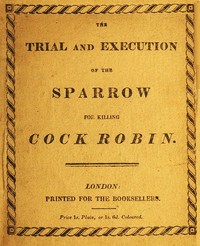
The Trial and Execution of the Sparrow for Killing Cock Robin — Reading Notes can be approached with a clearer sense of reading commitment from its source measurements: 4,072 words, 18 min estimated reading time, and 1 detected text section.
The text analysis averages about 22.9 words per sentence, while the detected sections provide another way to judge how the source is divided.
Project Gutenberg metadata also associates the work with “Birds -- Juvenile poetry,” connecting these edition facts with the source record’s subject description.
Explore this collection
These alternatives are selected using recorded categories and estimated reading time.
About 17 minutes
Animals
3,861 recorded words. 1 minutes difference from this book's estimate.
View Gutenberg source #22201About 16 minutes
Animals
3,559 recorded words. 2 minutes difference from this book's estimate.
View Gutenberg source #23482About 41 minutes
Animals
9,287 recorded words. 23 minutes difference from this book's estimate.
View Gutenberg source #73602Search stored excerpts and compare books → Choose by your preferences →
Choices use stored catalog measurements. Estimates vary with reading speed. A shared category is a catalog label, not a claim that two books have the same argument or literary quality.
Search reads excerpt text stored with this catalog and links to its associated Gutenberg record. The connection is stored in the site database; this tool does not recheck that every excerpt is word-for-word identical to that external record. Excerpt search does not cover every chapter and does not verify historical publication dates.
Catalog snapshot checked: 2026-09-26. Coverage: 99 public books, 99 available source excerpts.
Calculated from edition completeness, EPUB availability, text structure and catalogue metadata. Not a user rating.
Total of 100 points, scaled to a 2.5-5.0 range. Editions with an empty description or a missing EPUB file are not scored.
Public-domain source text
The source text is kept in the dedicated reader, separate from this catalogue record and its commentary.
This anonymous verse narrative, published in London as a chapbook priced at one shilling plain or one shilling sixpence coloured, expands the familiar nursery rhyme into a full-blown legal proceeding. The poem opens with Cock Robin's burial and the immediate dispatch of a constable—the Cuckoo—to fetch the Sparrow, who is found "robbing a barn." From there, the text proceeds through a mock trial presided over by Justice Hawk, with a jury, witnesses, and a coroner's inquest, before culminating in the Sparrow's execution. The work is notable for its sustained comic treatment of legal formalities applied to the bird world, and for the variety of animal voices it assembles.
The poem constructs its legal apparatus with deliberate absurdity. Justice Hawk instructs the jury that "when a bird's life's at stake, / Its a serious affair," yet the proceedings are anything but solemn. Witnesses include the Magpie, who "began for to chatter" about seeing the shot; Doctor Puss (the cat), who examined the wound and found Robin "quite dead and Cold, / So was not very hot"; and the Dog, who notes that without his intervention, "Doctor Puss / Would have eaten his patient." The Coroner, an Ass, reports that the jury "put on our spectacles, / Those who had got 'em" and discovered the wound "just in his bottom." These details undercut the gravity of the trial while maintaining the structure of a formal inquest.
The poem's cast of witnesses offers a range of perspectives, each rendered in a distinctive voice. The Drake, swimming with his Duck, saw the Sparrow on a tree but hedges: "I shot, I believe, / But I'm sure I don't know." The Swan, drifting "between sleep and awake, / In a sort of a dream," saw the arrow fly—"or else I dreamt so." The Cock gave the alarm with "such a loud crow" that he would have waked Robin had he been asleep. The Turkey was roused by the noise and saw the Bat pursuing the Sparrow, but never the bow or arrow. The Bat, a constable of the night, admits his candle was out but claims "I've a pretty good sight." These testimonies are comically unreliable, blending certainty with doubt and dream.
The Sparrow protests his innocence, asserting that both he and his wife "are as honest as ever / You was in your life" and that they merely picked up a few grains of wheat at the barn door. Despite this plea, the trial proceeds to a guilty verdict. The execution is carried out by the Hangman, and the poem concludes with a moral couplet: "Let this a warning be to all, / How they upon a sparrow fall." The narrative thus transforms a simple rhyme into a cautionary tale about justice, evidence, and the consequences of actions, all while maintaining a tone of mock solemnity.
Readers should note that the text is a chapbook, likely intended for both children and adults, and its humor derives from the incongruity between the serious legal framework and the trivial, animal subject matter. The poem rewards attention to the individual voices of the witnesses, each contributing a different kind of evidence—or lack thereof. The work stands as a curious artifact of 19th-century children's literature, blending moral instruction with parody.
Reading about the sparrow’s solemn trial, I recalled the quiet, patient justice in The Wonders of the Jungle, Book Two — Story, Setting & Ideas, where animals move beneath trees that seem to hold their own ancient court. Both books let the small and wingéd carry a weight of order, as if nature keeps a ledger I’d forgotten to look for.
Create a short personal record of your experience with this book.