About 422 minutes
The Way of the Wild — Reading Notes
Animals
96,835 recorded words. 13 minutes difference from this book's estimate.
View Gutenberg source #17567
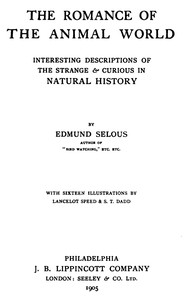
The romance of the animal world — Text and Context can be approached with a clearer sense of reading commitment from its source measurements: 93,960 words, 6 hr 49 min estimated reading time, and 29 detected text sections.
The text analysis averages about 33.0 words per sentence, while the detected sections provide another way to judge how the source is divided.
Project Gutenberg metadata also associates the work with “Animals,” connecting these edition facts with the source record’s subject description.
Explore this collection
These alternatives are selected using recorded categories and estimated reading time.
About 422 minutes
Animals
96,835 recorded words. 13 minutes difference from this book's estimate.
View Gutenberg source #17567About 423 minutes
Animals
97,064 recorded words. 14 minutes difference from this book's estimate.
View Gutenberg source #67073About 424 minutes
Animals
97,298 recorded words. 15 minutes difference from this book's estimate.
View Gutenberg source #17748Search stored excerpts and compare books → Choose by your preferences →
Choices use stored catalog measurements. Estimates vary with reading speed. A shared category is a catalog label, not a claim that two books have the same argument or literary quality.
Search reads excerpt text stored with this catalog and links to its associated Gutenberg record. The connection is stored in the site database; this tool does not recheck that every excerpt is word-for-word identical to that external record. Excerpt search does not cover every chapter and does not verify historical publication dates.
Catalog snapshot checked: 2026-09-26. Coverage: 99 public books, 99 available source excerpts.
Calculated from edition completeness, EPUB availability, text structure and catalogue metadata. Not a user rating.
Total of 100 points, scaled to a 2.5-5.0 range. Editions with an empty description or a missing EPUB file are not scored.
Public-domain source text
The source text is kept in the dedicated reader, separate from this catalogue record and its commentary.
Edmund Selous opens The Romance of the Animal World with a frontispiece depicting a peccary mistaken about an alligator's tail—a moment that encapsulates the book's taste for sudden, graphic action. The narrative voice oscillates between patient explanation and theatrical flourish, as when a beaver dam is described with the same analytical care a miller might use, yet the prose can pivot to a predator's strike in a single sentence. This tension between the methodical and the startling defines Selous's approach to natural history.
Selous frequently stages encounters as miniature dramas. The frontispiece episode—where an alligator uses its tail as a spring to fling a peccary into its jaws—is typical: the action is broken into precise, almost cinematic steps. Elsewhere, a spider is caught by a wasp, an osprey stoops on its prey, and ants wage war. These scenes are not merely reported; they are paced for maximum impact, with short clauses and active verbs accelerating the rhythm. The violence is never gratuitous, but it is central to Selous's idea of 'romance'—the thrill of nature red in tooth and claw.
The beaver chapter offers a striking contrast in pace. Here Selous slows down, adopting the tone of a civil engineer explaining hydraulics. He notes that beavers curve their dams upstream to reduce water pressure—a principle, he remarks, that humans apply to sea-dams and bridge buttresses. The description is methodical: earth, sticks, stones, and the gradual rise of the dam above the stream. Selous even admits he cannot 'formulate' the principle himself, a rare moment of self-deprecation that humanizes the narrator. This section demonstrates his ability to shift from dramatic to didactic, using technical detail to build admiration for animal intelligence.
Selous's narrator is not a neutral recorder. He addresses the reader directly ('we say'), offers opinions ('more scientific principles'), and occasionally confesses ignorance. In the beaver passage, he compares the dam to a flour-mill, then adds that beavers 'existed long before there were any millers.' Such asides create a conversational intimacy. Yet the voice can also be arch: a penguin colony is described as an 'innocent army,' and a bird's nest as a 'city of grass.' This blend of earnest naturalism and wry commentary gives the prose a distinctive, slightly old-fashioned charm, inviting the reader to share in Selous's curiosity and amusement.
Readers will find that Selous's book rewards attention to its shifts in register: the same author who lingers over a beaver's dam can dispatch a peccary in two sentences. The illustrations by Lancelot Speed and Stephen T. Dadd complement this dual focus, capturing both the serene and the savage. Approach the text as a series of discrete episodes, each with its own tempo, and Selous's 'romance' emerges as a careful balance of wonder and precision.
Selous’s old book left me with the strange ache of a world where beavers build and peccaries tear, all described with a hand that trembled between science and awe. I keep coming back to that tender violence. It’s why I finally settled into The Way of the Wild — Reading Notes, which feels like sitting beside someone who watched the same animals and chose to whisper instead of shout.
Save your reaction, strongest insight, and memorable passage.