About 304 minutes
Birds of the Plains — Story, Setting & Ideas
Birds
69,882 recorded words. 3 minutes difference from this book's estimate.
View Gutenberg source #46394
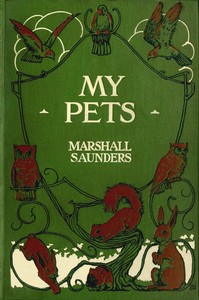
My pets — Themes and Context can be approached with a clearer sense of reading commitment from its source measurements: 69,229 words, 5 hr 1 min estimated reading time, and 38 detected text sections.
The text analysis averages about 20.9 words per sentence, while the detected sections provide another way to judge how the source is divided.
Project Gutenberg metadata also associates the work with “Birds,” connecting these edition facts with the source record’s subject description.
Explore this collection
These alternatives are selected using recorded categories and estimated reading time.
About 304 minutes
Birds
69,882 recorded words. 3 minutes difference from this book's estimate.
View Gutenberg source #46394About 297 minutes
Birds
68,144 recorded words. 4 minutes difference from this book's estimate.
View Gutenberg source #46055About 312 minutes
Birds
71,646 recorded words. 11 minutes difference from this book's estimate.
View Gutenberg source #65440Search stored excerpts and compare books → Choose by your preferences →
Choices use stored catalog measurements. Estimates vary with reading speed. A shared category is a catalog label, not a claim that two books have the same argument or literary quality.
Search reads excerpt text stored with this catalog and links to its associated Gutenberg record. The connection is stored in the site database; this tool does not recheck that every excerpt is word-for-word identical to that external record. Excerpt search does not cover every chapter and does not verify historical publication dates.
Catalog snapshot checked: 2026-09-26. Coverage: 99 public books, 99 available source excerpts.
Calculated from edition completeness, EPUB availability, text structure and catalogue metadata. Not a user rating.
Total of 100 points, scaled to a 2.5-5.0 range. Editions with an empty description or a missing EPUB file are not scored.
Public-domain source text
The source text is kept in the dedicated reader, separate from this catalogue record and its commentary.
Marshall Saunders’ My Pets opens with a specific origin: two Californian screech owls acquired in 1899 while the author was studying boy life at Belmont School near San Francisco. The book is presented not as fiction but as a diary-based record of an aviary, with the author noting that many of the birds described were still living at the time of writing. The dedication addresses readers who demand entirely true stories, and the text repeatedly grounds its claims in personal observation rather than general natural history.
The book’s structure follows the author’s direct experience, beginning with the acquisition of the owls and moving through a series of chapters on different species. The table of contents lists chapters on robins, mockingbirds, sparrows, pigeons, canaries, cardinals, and others, each apparently drawn from diary entries. The author states explicitly that the story of the aviary is “taken from my diaries,” and the narrative voice is consistently first-person and present-tense in describing ongoing events. This method produces a record that is episodic rather than synthetic, with each chapter focusing on a particular bird or group. The text does not attempt to cover all bird species systematically but instead follows the author’s changing interests and the birds that came into her care.
One extended passage concerns a pigeon named Whistler, whose behavior is described in considerable detail. Whistler is portrayed as aggressive, engaging in mock fights with the author’s father, who wore gloves to spar with the bird. The pigeon’s interactions with other birds are also noted: he bullied a lame tumbler named Crippie and was avoided by another pigeon, Sukey. The author describes Whistler’s apparent delight at being brought indoors, where he treated a sandal as a companion and sat on a nest with an egg. These observations are presented as factual occurrences, with the author interpreting the bird’s actions in anthropomorphic terms—Whistler “talked” to the sandals and “bowed politely”—but the underlying behavior is documented with specificity.
Another detailed account involves Sukey, a pigeon who developed unusual nest-building habits. The author describes dismantling a nest that contained “assorted sizes of hairpins, a black-headed pin, a half-burnt match, a withered mayflower, a feather from an indigo bunting’s wing, and some little sticks.” Sukey is also reported to have tossed the author’s mother’s spectacles in the air and stolen a garnet ring from a dressing-table. These incidents are presented as evidence of the bird’s individual personality and intelligence, not as generic pigeon behavior. The author’s method is to record specific, often quirky actions, and the text avoids generalizing about species-wide traits. The focus remains on the particular birds in the aviary and their unique habits.
Readers interested in the intersection of personal observation and natural history will find My Pets a document of one person’s sustained engagement with birds. The book does not offer scientific analysis or broad conclusions; instead, it presents a series of incidents that reveal the author’s close attention to individual animals. Those approaching it as a source for bird behavior should note that the accounts are filtered through the author’s interpretive lens and are not systematic. The value lies in the specificity of the anecdotes and the author’s evident familiarity with her subjects.
I keep thinking about how those birds in the diary felt like quiet presences, each with their own stubborn little personality. There’s something similar in Bob: The Story of Our Mocking-bird — Background and Themes, where a single bird’s habits start to feel like a familiar room you return to. It lingered, softly, like an old song.
Your answers remain private and are stored only in this browser.