About 315 minutes
Birds in London — A Closer Reading
Birds
72,257 recorded words. 3 minutes difference from this book's estimate.
View Gutenberg source #40334
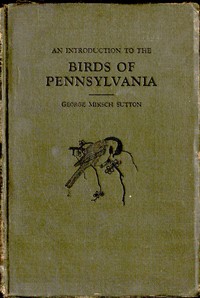
The source record for An Introduction to the Birds of Pennsylvania — Reading Companion measures this digital text at 71,646 words, 5 hr 12 min estimated reading time, and 13 detected text sections.
The text analysis averages about 15.5 words per sentence, while the detected sections provide another way to judge how the source is divided.
Project Gutenberg metadata also associates the work with “Birds -- Pennsylvania,” connecting these edition facts with the source record’s subject description.
Explore this collection
These alternatives are selected using recorded categories and estimated reading time.
About 315 minutes
Birds
72,257 recorded words. 3 minutes difference from this book's estimate.
View Gutenberg source #40334About 304 minutes
Birds
69,882 recorded words. 8 minutes difference from this book's estimate.
View Gutenberg source #46394About 301 minutes
Birds
69,229 recorded words. 11 minutes difference from this book's estimate.
View Gutenberg source #73801Search stored excerpts and compare books → Choose by your preferences →
Choices use stored catalog measurements. Estimates vary with reading speed. A shared category is a catalog label, not a claim that two books have the same argument or literary quality.
Search reads excerpt text stored with this catalog and links to its associated Gutenberg record. The connection is stored in the site database; this tool does not recheck that every excerpt is word-for-word identical to that external record. Excerpt search does not cover every chapter and does not verify historical publication dates.
Catalog snapshot checked: 2026-09-26. Coverage: 99 public books, 99 available source excerpts.
Calculated from edition completeness, EPUB availability, text structure and catalogue metadata. Not a user rating.
Total of 100 points, scaled to a 2.5-5.0 range. Editions with an empty description or a missing EPUB file are not scored.
Public-domain source text
The source text is kept in the dedicated reader, separate from this catalogue record and its commentary.
George Miksch Sutton, writing as State Ornithologist of Pennsylvania in 1928, designed this manual explicitly for beginners and field students. The prefatory note states it is not a complete reference work; many recorded species are omitted to simplify the list. Sutton stresses points important to the field student and eliminates material that might cause confusion. He deliberately chose pen-and-ink drawings over color illustrations, arguing that colored plates often lead beginners to expect too much from brief glimpses of birds in the field.
The catalog subject is simply "Birds -- Pennsylvania," but the excerpts reveal a work deeply concerned with identification methods—especially call notes, habitat, and seasonal timing—rather than exhaustive description. Sutton's dedication to his mother, who "let me bring them, alive, dead, or worse than dead, into her busy household," hints at a personal, practical ethos underlying the scientific content.
Sutton repeatedly emphasizes that the small flycatchers—dull olive-green birds with wing-bars and eye-rings—are "reasonably easy to identify in the field, chiefly from their call-notes." He provides phonetic renderings for each species: the Yellow-bellied Flycatcher's tsek or chuh-bec, the Acadian's explosive pit-i-yuk or wee-zee-eep, the Alder's becky-weer, and the Least Flycatcher's energetic che-bec delivered with a violent toss of the head. He even warns that the Eastern Wood Pewee's song is "often almost perfectly imitated by the Starling," so that pewee songs heard in winter or unlikely places should be investigated. This reliance on vocalizations reflects the practical challenge of identifying visually similar species in the field.
Each species account ties the bird to a precise habitat and seasonal window. The Acadian Flycatcher lives "in shadowy woodlands along ravines" where beech, maple, or hemlock overhang a stream; Sutton warns not to look for it in swamps or orchards. The Alder Flycatcher is found "in low growth along streams or in swamps, often actually among alders." The Least Flycatcher prefers "open aspen copses or orchards." Seasonal occurrence is given with care: the Yellow-bellied Flycatcher is a migrant in mid-spring and early autumn, nesting only at one or two high altitudes; the Acadian comes in early May and stays until mid-September. These details allow the reader to narrow possibilities by place and date.
Sutton's prefatory note explains that many species recorded in Pennsylvania are not mentioned, so as "to simplify the list for the beginner, who is confronted with a sufficiently formidable array of new and strange names as it is." He acknowledges that thorough works are needed—citing volumes by W. E. Clyde Todd and Witmer Stone then in preparation—but offers this manual as an interim guide. The excerpts show that even within included species, descriptions are brief: the Horned Lark entry, for instance, is a single paragraph contrasting the northern relative with the Prairie Horned Lark. Sutton's approach is to equip the beginner with enough to identify common birds without overwhelming detail, a strategy evident in the concise, field-oriented accounts.
Sutton's manual is best used as a companion in the field, not a desk reference. Readers should pay close attention to the phonetic call notes and habitat descriptions, which are the book's core identification tools. The pen-and-ink drawings, while simple, are intended to be adequate for field work; Sutton believed they avoid the misleading perfection of color plates. For those who keep ornithological notes, Sutton hopes their records will contribute to the larger, more exhaustive works he knew were needed.
Sometimes I think of Sutton’s quiet insistence that a bird is known best by its call and its place, and I remember another old volume on my shelf, Big Game Shooting, volume 1 (of 2) — Context and Discussion, with its patient attention to terrain and habit. Both felt less like manuals, more like someone sharing what they’d learned by simply watching.
Build a private reading journal entry for this title.