About 248 minutes
Wild Life Near Home — Reading Notes
Birds
56,979 recorded words. 6 minutes difference from this book's estimate.
View Gutenberg source #42871
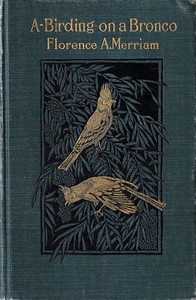
Before opening A-Birding on a Bronco — Themes and Context, the edition data offers a quick orientation: 58,278 words, 4 hr 14 min estimated reading time, and 11 detected text sections.
The text analysis averages about 21.2 words per sentence, while the detected sections provide another way to judge how the source is divided.
Project Gutenberg metadata also associates the work with “Birds,” connecting these edition facts with the source record’s subject description.
Explore this collection
These alternatives are selected using recorded categories and estimated reading time.
About 248 minutes
Birds
56,979 recorded words. 6 minutes difference from this book's estimate.
View Gutenberg source #42871About 297 minutes
Birds
68,144 recorded words. 43 minutes difference from this book's estimate.
View Gutenberg source #46055About 301 minutes
Birds
69,229 recorded words. 47 minutes difference from this book's estimate.
View Gutenberg source #73801Search stored excerpts and compare books → Choose by your preferences →
Choices use stored catalog measurements. Estimates vary with reading speed. A shared category is a catalog label, not a claim that two books have the same argument or literary quality.
Search reads excerpt text stored with this catalog and links to its associated Gutenberg record. The connection is stored in the site database; this tool does not recheck that every excerpt is word-for-word identical to that external record. Excerpt search does not cover every chapter and does not verify historical publication dates.
Catalog snapshot checked: 2026-09-26. Coverage: 99 public books, 99 available source excerpts.
Calculated from edition completeness, EPUB availability, text structure and catalogue metadata. Not a user rating.
Total of 100 points, scaled to a 2.5-5.0 range. Editions with an empty description or a missing EPUB file are not scored.
Public-domain source text
The source text is kept in the dedicated reader, separate from this catalogue record and its commentary.
Florence Merriam Bailey opens A-Birding on a Bronco with a practical confession: the field notes from which the book is drawn were taken during two short seasons—March to May 1889 and March to July 1894—at Twin Oaks in southern California. She admits that because no collecting was done, the identity of a few species remains uncertain, and she has left their names blank or questioned in the list of birds. This honest framing sets the tone for a work that values careful watching over taxonomic certainty.
The book’s structure follows the rhythm of her rides on Mountain Billy, a horse whose name appears in chapter titles and whose movements shape the narrative. Bailey’s prose moves between patient observation—waiting for a bird to reappear—and sudden action, as when she turns Billy toward a snake or listens to a German mower sing while mowing the very spot where a rattler had been.
Bailey’s choice to conduct her birding on horseback is not merely a convenience but a narrative device. Mountain Billy is a character in his own right, and the author’s attention to his reactions—holding his head up “in consideration of the snakes,” or standing still while she waits for birds—creates a partnership that defines the book’s voice. The horse’s presence allows Bailey to move through the valley with a blend of control and vulnerability: she can follow birds into the weeds, but she also depends on Billy’s instincts to avoid danger. When she spots a snake at his feet, her first thought is for his safety, not her own. This interdependence gives the observations a grounded, embodied quality, as if the reader is riding alongside her.
Bailey’s language is marked by a careful balance between exact description and admitted doubt. She notes that a snake “marked like a rattler” had a blunt tail, which she knew distinguished the harmless gopher snake from the rattler—but in the dim light she “could not make out whether it had rattles or not.” This moment of uncertainty is typical: she records what she sees, but does not pretend to certainty when conditions are poor. Similarly, in the prefatory note she explains that when plumage of the two sexes is identical, she has “sometimes been arbitrarily distinguished in the text.” Such candor is rare in nature writing of the period and gives the book a scientific integrity that complements its narrative charm.
Bailey’s descriptions are as much about listening as looking. She recalls the “wonderful freshness of California’s fog-cleared skies” during morning rides, and the “peacefulness of the quiet valley at twilight.” But sound also interrupts: the German mower’s “deep rich voice” singing a melody, then a “harsh cry to his mules.” The contrast between the man’s singing and his workaday shout mirrors the book’s own shifts between lyrical observation and practical field notes. Bailey also notes the “tranquil birds singing their evening songs” as the sun sets, but she does not romanticize the scene—the same valley holds rattlesnakes, and the mower kills one and hangs it on a branch for her to see. The soundscape is layered, never simple.
Bailey adopts a playful but precise metaphor when she describes herself as an “ornithological landlady” whose ranch is home to “tenants”—the birds nesting in the sycamores and willows. This framing allows her to combine scientific attention with a sense of domestic stewardship. She rides “along the shady line and making friendly calls at each tree,” as if checking on lodgers. The metaphor is not merely cute; it reflects a real concern for the birds’ welfare. She notes that “so many houses were being put up without so much as a by-your-leave” that she had to “bestir herself and look to her ornithological squatters.” The humor is understated, but the underlying message is serious: the valley is a shared habitat, and Bailey sees herself as its responsible observer.
Readers approaching A-Birding on a Bronco should expect a hybrid work—part field journal, part travel narrative, part character study of a horse and a landscape. Bailey’s prose rewards attention to small details: the way she notes a bird’s song, the shape of a snake’s tail, or the color of the light at sunset. She does not claim to have seen everything, and she is not afraid to leave a question mark in the margin. This honesty makes the book a refreshingly grounded entry in the natural history tradition, one that invites the reader to ride alongside her and look carefully.
I recall Miss Bailey, her pony pausing beneath a sycamore while a wren scolded unseen. She was honest about her uncertainty, which makes her company so dear. A similar patience fills Everyday birds, turning the common into something gently known. The kinship is quiet, like two people who have watched the same dawn and agreed not to speak of it. Everyday birds: Elementary studies — Reading Notes holds that same unhurried truth.
Your answers remain private and are stored only in this browser.