About 124 minutes
How To Have Bird Neighbors — Story, Setting & Ideas
Birds
28,383 recorded words. 11 minutes difference from this book's estimate.
View Gutenberg source #65548
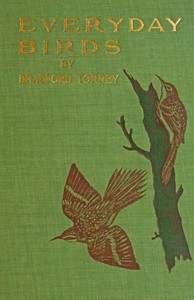
The source record for Everyday birds: Elementary studies — Reading Notes measures this digital text at 25,791 words, 1 hr 53 min estimated reading time, and 29 detected text sections.
The text analysis averages about 22.3 words per sentence, while the detected sections provide another way to judge how the source is divided.
Project Gutenberg metadata also associates the work with “Birds -- Popular works,” connecting these edition facts with the source record’s subject description.
Explore this collection
These alternatives are selected using recorded categories and estimated reading time.
About 124 minutes
Birds
28,383 recorded words. 11 minutes difference from this book's estimate.
View Gutenberg source #65548About 90 minutes
Birds
20,657 recorded words. 23 minutes difference from this book's estimate.
View Gutenberg source #34556About 70 minutes
Birds
16,089 recorded words. 43 minutes difference from this book's estimate.
View Gutenberg source #52600Search stored excerpts and compare books → Choose by your preferences →
Choices use stored catalog measurements. Estimates vary with reading speed. A shared category is a catalog label, not a claim that two books have the same argument or literary quality.
Search reads excerpt text stored with this catalog and links to its associated Gutenberg record. The connection is stored in the site database; this tool does not recheck that every excerpt is word-for-word identical to that external record. Excerpt search does not cover every chapter and does not verify historical publication dates.
Catalog snapshot checked: 2026-09-26. Coverage: 99 public books, 99 available source excerpts.
Calculated from edition completeness, EPUB availability, text structure and catalogue metadata. Not a user rating.
Total of 100 points, scaled to a 2.5-5.0 range. Editions with an empty description or a missing EPUB file are not scored.
Public-domain source text
The source text is kept in the dedicated reader, separate from this catalogue record and its commentary.
Bradford Torrey opens Everyday Birds with a striking contrast: the California condor, with its nine-and-a-half-foot wingspan, and the hummingbird, whose wings measure less than an inch and a half. Between these extremes he places the kinglets, “little kings” named for their tiny size. This taxonomic framing sets the tone for a collection that moves nimbly between scientific observation and personal anecdote. Torrey’s voice is that of a seasoned naturalist who delights in correcting popular errors—not through lecture, but through stories that unfold at the pace of a country walk.
Torrey frequently builds his essays around a remembered conversation or encounter. In the chapter on nighthawks and whip-poor-wills, he recounts a farmer who insists the two birds are the same species—“the he one and t’ other’s the she one.” Rather than dismiss the man, Torrey lets the dialogue stand, then gently supplies evidence: the nighthawk is crepuscular, often flying at midday; the whip-poor-will sings only after dark. He even cites a Massachusetts egg collector who shared the same confusion. This method—letting error be voiced before correction—gives the prose a patient, almost Socratic rhythm. The reader is not told what to think but is led to observe along with the author.
Torrey’s narrative pace shifts with his subject. When describing the kinglet’s nest-building, he quickens the tempo: “his movements are so rapid” and he “acts upon the old motto, ‘Try, try again.’” The sentence structure mirrors the bird’s darting energy. By contrast, the discussion of nighthawk flight is measured, almost leisurely: “The bird rises gradually to a considerable height, and presently drops like a stone almost to the ground.” Torrey notes he has observed this aerial display from Boston’s Public Garden, grounding the description in a specific, urban setting. His language is precise without being technical—he calls the nighthawk’s call “guttural-nasal,” a phrase that conveys sound without jargon.
The available excerpts cover only two chapters: “Two Little Kings” and “Nighthawk and Whip-poor-will.” From these, we see Torrey’s fondness for dialogue and his habit of embedding natural history in social exchange. But the full table of contents lists twenty-one chapters, including studies of the chickadee, brown creeper, song sparrow, and blue jay. Whether Torrey maintains the same anecdotal structure throughout—or shifts to a more systematic approach in later chapters—cannot be determined from the sample. Readers should expect a mix of close observation and personal narrative, but the book’s overall arc remains unknown from these pages alone.
Torrey’s essays reward the reader who attends to his asides and digressions. The farmer who mistakes bluebirds for “blue snowbirds” is not a foil but a fellow observer, however mistaken. In Everyday Birds, science proceeds by conversation, and the naturalist’s authority is worn lightly. Approach these studies as you might a walk with a knowledgeable companion: ready to pause, to question, and to look again.
That rainy afternoon, Everyday Birds sat open on my lap, Torrey’s gentle, amused patience seeping into the gray light. His quiet watching made me think of other men, equally patient, waiting for something bigger. I closed the birds and, without quite meaning to, pulled down Big Game Shooting, volume 2 (of 2) — Reading Companion. Different prey, same stillness. The rain kept falling, and I just turned pages.
Save your reaction, strongest insight, and memorable passage.