About 632 minutes
Wild Spain (España agreste) Records of Sport with Rifle, Rod, and Gun, Natural History Exploration — Inside the Classic
Birds
145,165 recorded words. 2 minutes difference from this book's estimate.
View Gutenberg source #38201
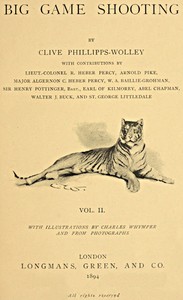
For Big Game Shooting, volume 2 (of 2) — Reading Companion, the stored edition analysis reports 144,823 words, 10 hr 30 min estimated reading time, and 21 detected text sections.
The text analysis averages about 26.1 words per sentence, while the detected sections provide another way to judge how the source is divided.
Project Gutenberg metadata also associates the work with “Hunting,” connecting these edition facts with the source record’s subject description.
Explore this collection
These alternatives are selected using recorded categories and estimated reading time.
About 632 minutes
Birds
145,165 recorded words. 2 minutes difference from this book's estimate.
View Gutenberg source #38201About 713 minutes
Birds
163,880 recorded words. 83 minutes difference from this book's estimate.
View Gutenberg source #48584About 769 minutes
Birds
176,667 recorded words. 139 minutes difference from this book's estimate.
View Gutenberg source #73940Search stored excerpts and compare books → Choose by your preferences →
Choices use stored catalog measurements. Estimates vary with reading speed. A shared category is a catalog label, not a claim that two books have the same argument or literary quality.
Search reads excerpt text stored with this catalog and links to its associated Gutenberg record. The connection is stored in the site database; this tool does not recheck that every excerpt is word-for-word identical to that external record. Excerpt search does not cover every chapter and does not verify historical publication dates.
Catalog snapshot checked: 2026-09-26. Coverage: 99 public books, 99 available source excerpts.
Calculated from edition completeness, EPUB availability, text structure and catalogue metadata. Not a user rating.
Total of 100 points, scaled to a 2.5-5.0 range. Editions with an empty description or a missing EPUB file are not scored.
Public-domain source text
The source text is kept in the dedicated reader, separate from this catalogue record and its commentary.
The second volume of Big Game Shooting opens not with a single authorial voice but with a chorus of contributors, each bringing a distinct rhythm to the prose. Arnold Pike’s Arctic hunting chapter moves with the deliberate pace of a stalk across ice, while Clive Phillipps-Wolley’s Caucasus sections shift into a more breathless, immediate register during moments of action. The book’s structure—alternating between regional surveys and practical appendices on rifles, taxidermy, and camp transport—creates a deliberate change in tempo, from the narrative flow of a hunting story to the clipped, data-driven cadence of a reference table.
The volume is a collaborative work, with chapters by Arnold Pike, St. G. Littledale, W. A. Baillie-Grohman, and others. Each writer’s voice is distinct: Pike’s Arctic narrative is measured and descriptive, while Littledale’s account of the Ovis Poli is terse and focused on practical details. Phillipps-Wolley, as editor, contributes a more reflective tone, especially in his chapters on camps and transport. The result is a polyphonic text where the reader must adjust to shifting styles—from the lyrical description of a chamois stalk to the blunt enumeration of tiger measurements. This variety mirrors the diversity of the hunting grounds themselves, from the frozen north to the Indian jungle.
The prose often alternates between sustained narrative and abrupt technical data. A typical chapter might begin with a vivid scene—‘Waiting for the Dawn’—then break into a table of measurements or a list of rifles. This structural change in pace is not accidental; it reflects the dual purpose of the Badminton Library: to entertain and to instruct. The reader is pulled from the immediacy of a stalk into the cool analysis of ballistics or taxidermy. For instance, the chapter on Indian shooting includes a lengthy table of tiger weights and lengths, a statistical interlude that contrasts sharply with the preceding account of a charge. This oscillation between story and data is a defining feature of the volume’s narrative voice.
Throughout the volume, language is marked by a concern for exactness. Contributors frequently cite measurements—‘12 ft. 2 in.’ for a tiger’s length, ‘530 lbs.’ for its weight—and qualify their sources (‘Sterndale’s Mammalia’, ‘Letter to The Asian’). This habit of precise observation extends to descriptions of terrain and animal behavior: a bear is ‘killed by a tiger in Chumba, on barasingh ground.’ The prose is dense with specific place names, species, and technical terms (e.g., ‘gutturosa’, ‘Ovis Poli’). Such language roots the narrative in a world of empirical detail, where a hunter’s credibility rests on the accuracy of his report. The reader is invited to trust not just the story but the numbers behind it.
Readers approaching this volume should be prepared for its hybrid nature: part travelogue, part manual, part statistical compendium. The shifts in pace and voice are not flaws but features of a work that aims to be both a record of adventure and a practical guide. Pay attention to the footnotes and asides—they often contain the most telling details about the conditions of the hunt and the character of the hunter. The book rewards a patient, attentive reading, one that moves with the same deliberate care as a stalker on the hillside.
I remember turning pages of this old volume on a grey afternoon, the damp smell of its cloth binding, and thinking how every stalk is finally a quiet arithmetic of patience and winds. It recalled something softer, though—the way Birds in London — A Closer Reading once made city sparrows feel as remote as Himalayan game, each sighting a small, held breath.
Your answers remain private and are stored only in this browser.