About 1,035 minutes
Ornithological biography, Vol. 2 (of 5) — Key Ideas to Explore
Birds
237,825 recorded words. 28 minutes difference from this book's estimate.
View Gutenberg source #57191
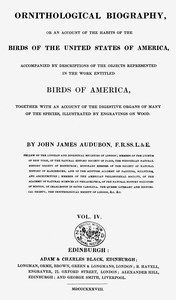
The source record for Ornithological biography, Vol. 4 (of 5) — Themes and Context measures this digital text at 244,325 words, 17 hr 43 min estimated reading time, and 109 detected text sections.
The text analysis averages about 27.6 words per sentence, while the detected sections provide another way to judge how the source is divided.
Project Gutenberg metadata also associates the work with “Birds -- North America,” connecting these edition facts with the source record’s subject description.
Explore this collection
These alternatives are selected using recorded categories and estimated reading time.
About 1,035 minutes
Birds
237,825 recorded words. 28 minutes difference from this book's estimate.
View Gutenberg source #57191About 1,150 minutes
Birds
264,447 recorded words. 87 minutes difference from this book's estimate.
View Gutenberg source #69403About 902 minutes
Birds
207,341 recorded words. 161 minutes difference from this book's estimate.
View Gutenberg source #56989Search stored excerpts and compare books → Choose by your preferences →
Choices use stored catalog measurements. Estimates vary with reading speed. A shared category is a catalog label, not a claim that two books have the same argument or literary quality.
Search reads excerpt text stored with this catalog and links to its associated Gutenberg record. The connection is stored in the site database; this tool does not recheck that every excerpt is word-for-word identical to that external record. Excerpt search does not cover every chapter and does not verify historical publication dates.
Catalog snapshot checked: 2026-09-26. Coverage: 99 public books, 99 available source excerpts.
Calculated from edition completeness, EPUB availability, text structure and catalogue metadata. Not a user rating.
Total of 100 points, scaled to a 2.5-5.0 range. Editions with an empty description or a missing EPUB file are not scored.
Public-domain source text
The source text is kept in the dedicated reader, separate from this catalogue record and its commentary.
The fourth volume of John James Audubon's Ornithological Biography opens with a striking claim: the accompanying illustrated work, Birds of America, was completed on June 20, 1838, after twelve years of uninterrupted production, delivering 435 plates and 1,065 figures. This volume, like its predecessors, pairs detailed anatomical measurements—such as the trachea of a heron being '3 1/2 inches long, 2 3/4 twelfths broad'—with narrative accounts of bird behavior drawn from Audubon's travels across the United States.
The excerpts reveal a dual focus: the precise, almost clinical descriptions of digestive organs and the lively, anecdotal reports of species like the Yellow-crowned Heron, which Audubon notes is called 'Cap-cap' by Creoles in Louisiana. Readers approaching this work for the first time will find that the text alternates between scientific rigor and personal observation, often within the same entry.
Each entry in this volume follows a consistent pattern that rewards careful reading. The account of the Yellow-crowned Heron, for example, begins with a common name and Linnaean classification, then moves to a physical description before launching into habitat and behavior. Audubon frequently includes local names—'Cap-cap' for this heron—and notes regional variations in abundance. He observes that the species is 'quite abundant' in parts of the Southern States but 'seldom or never met with' in intermediate tracts, a pattern he documents with specific locations: a bayou near Halifax River, a key two hundred miles south, and Galveston Island.
This structure allows readers to trace how Audubon builds a composite portrait from multiple encounters. The anatomical section, often contributed by William MacGillivray, appears later in the entry, with measurements given in twelfths of an inch and counts of tracheal rings. The two parts—narrative and anatomical—are distinct but complementary, reflecting the collaborative nature of the work.
Audubon's writing is richest when he recounts his own experiences in the field. For the Yellow-crowned Heron, he describes how hunters can entice the bird by imitating its cries, causing it to approach 'cutting many curious zigzags in the air.' He notes a peculiar behavior: when shot at and missed, the heron dives toward the ground repeatedly, 'according to the number of shots.' Such details are not merely colorful; they serve as practical knowledge for contemporary naturalists and collectors.
Audubon also records the heron's feeding habits, observing that it searches for food 'among the roots of mangroves at all hours of the day,' contradicting the notion that it is entirely nocturnal. He notes that after feeding, the birds 'would quietly remove to some safe distance' and stand 'in a crouching posture,' presenting 'a very singular appearance.' These observations are grounded in specific times and places—Galveston Island, the Florida Keys—giving the reader a sense of the geography of Audubon's research.
Interspersed with the narrative accounts are detailed anatomical descriptions, likely the work of William MacGillivray, listed as contributor. The excerpt includes measurements for a heron's digestive organs: the intestine is '19 1/2 inches long, its diameter 3 twelfths in its upper part,' with cœca '1 3/4 inch long.' The trachea is described as 'wide, flattened,' with 'about 130' rings. These figures are given in twelfths of an inch, a unit that appears consistently across the volume.
This anatomical data serves a dual purpose: it provides a scientific record for ornithologists and complements the illustrations in Birds of America. The volume's full title promises 'an account of the digestive organs of many of the species, illustrated by engravings on wood.' Readers should note that these sections are not separate essays but integrated into each species account, often following the behavioral description. The precision of the measurements—down to twelfths—reflects the empirical standards of nineteenth-century natural history.
Audubon's accounts are deeply rooted in specific locations, and he frequently comments on the geographic distribution of species. For the Yellow-crowned Heron, he notes that it arrives near New Orleans 'toward the end of March' and departs 'in the middle of October.' He observes that the species 'seldom advance eastward far beyond North Carolina' and is 'not generally found on the Mississippi beyond Natchez.' Such statements are based on his own travels and reports from correspondents.
He also remarks on the heron's migratory behavior, noting that it travels 'on fine clear nights' and that he has seen them 'come down from a considerable height in the air, after sun-rise.' The text includes caveats: 'stragglers may sometimes be seen farther up' the Mississippi, and the species is 'by no means entirely nocturnal.' These nuanced observations, grounded in specific encounters, give the reader a sense of the variability Audubon encountered across the vast landscapes he explored.
Readers approaching this volume for the first time will benefit from reading the introduction, which outlines the scope of the entire five-volume work and its relationship to the plates. The species accounts reward both sequential reading and targeted reference: the anatomical data is best consulted alongside the illustrations, while the narrative passages offer a window into Audubon's methods and the landscapes of early nineteenth-century America. The volume stands as a record of a naturalist at work, combining the precision of measurement with the immediacy of field observation.
Audubon’s patient twelve years, his careful notes on the heron’s zigzag, made me think of another quiet companion—Indian Birds: Being a Key to the Common Birds of the Plains of India — Context and Discussion. There is a similar feeling of a hand reaching out, naming what flies past, holding a small piece of the world still for a moment. The pace reminds me of slow afternoons, turning pages, watching.
Build a private reading journal entry for this title.