About 1,063 minutes
Ornithological biography, Vol. 4 (of 5) — Themes and Context
Birds
244,325 recorded words. 28 minutes difference from this book's estimate.
View Gutenberg source #72279
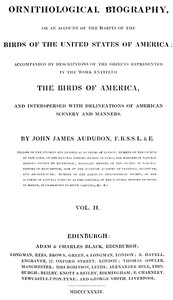
For Ornithological biography, Vol. 2 (of 5) — Key Ideas to Explore, the stored edition analysis reports 237,825 words, 17 hr 15 min estimated reading time, and 128 detected text sections.
The text analysis averages about 24.4 words per sentence, while the detected sections provide another way to judge how the source is divided.
Project Gutenberg metadata also associates the work with “Birds -- North America,” connecting these edition facts with the source record’s subject description.
Explore this collection
These alternatives are selected using recorded categories and estimated reading time.
About 1,063 minutes
Birds
244,325 recorded words. 28 minutes difference from this book's estimate.
View Gutenberg source #72279About 1,150 minutes
Birds
264,447 recorded words. 115 minutes difference from this book's estimate.
View Gutenberg source #69403About 902 minutes
Birds
207,341 recorded words. 133 minutes difference from this book's estimate.
View Gutenberg source #56989Search stored excerpts and compare books → Choose by your preferences →
Choices use stored catalog measurements. Estimates vary with reading speed. A shared category is a catalog label, not a claim that two books have the same argument or literary quality.
Search reads excerpt text stored with this catalog and links to its associated Gutenberg record. The connection is stored in the site database; this tool does not recheck that every excerpt is word-for-word identical to that external record. Excerpt search does not cover every chapter and does not verify historical publication dates.
Catalog snapshot checked: 2026-09-26. Coverage: 99 public books, 99 available source excerpts.
Calculated from edition completeness, EPUB availability, text structure and catalogue metadata. Not a user rating.
Total of 100 points, scaled to a 2.5-5.0 range. Editions with an empty description or a missing EPUB file are not scored.
Public-domain source text
The source text is kept in the dedicated reader, separate from this catalogue record and its commentary.
Audubon opens this volume with a detailed defense of his species identification for Henslow's Bunting, directly challenging Sir William Jardine's published remarks. He insists the bird is distinct from salt-marsh sparrows, noting it inhabits dry meadows and pine forests—a claim backed by hundreds of specimens collected during his rambles. This combative, evidence-driven tone recurs throughout, as Audubon repeatedly uses measurement tables and plumage comparisons to settle taxonomic disputes.
Audubon's descriptions are built around precise measurements—bill length, tarsus, wing span—and careful color notation. For Macgillivray's Finch, he gives a full table of dimensions and notes that bills vary greatly with age, a detail that undermines simplistic identification. He also corrects Wilson's figure of Henslow's Bunting, calling it 'incorrect' and asserting that his own illustration is accurate. These passages show Audubon treating taxonomy as a form of testimony, where firsthand observation outweighs earlier published plates.
The catalog subject 'Birds -- North America' is accurate but reductive: the excerpts reveal a work equally concerned with correcting the historical record. Audubon names his sources—Wilson, Jardine—and uses them as foils to establish his own authority.
William MacGillivray is listed as contributor, and his presence is felt in the finch description: the species is named 'Macgillivray's Finch,' and its traits are compared to two other species in a systematic way. The text includes a note that MacGillivray's Finch is intermediate in size and combines the coloring of both relatives. This suggests a collaborative method of comparison and classification, not merely Audubon's solo fieldwork.
Yet the excerpts also show Audubon's proprietary voice: he writes 'my friends, my assistants, and myself procured hundreds of specimens.' The volume thus oscillates between collective science and personal narrative, a tension the catalog entry does not capture.
Audubon does not limit himself to morphology. For the Red-eyed Vireo, he describes foraging behavior—'moving about, and along the branches or the twigs of the trees, by light hops'—and contrasts it with flycatchers. This behavioral observation is woven into the taxonomic argument: Henslow's Bunting is distinguished partly by its habitat (dry meadows, not salt marshes).
The excerpts also include a lengthy transcriber's note listing inconsistencies in spelling and possible errors, reminding readers that the text is a reconstruction from multiple print editions. The volume's authority is thus mediated by editorial intervention, a layer the original catalog does not acknowledge.
Readers should approach this volume as a hybrid: part field guide, part taxonomic polemic, part collaborative manuscript. The catalog subject 'Birds -- North America' is accurate but incomplete. Pay attention to the footnotes and the transcriber's notes, which reveal the text's contested history. Audubon's voice is confident, but the evidence shows a scientist constantly defending his ground against peers.
Rain drummed on the windowsill that afternoon while I followed Audubon’s patient corrections, noticing how each sharpened observation seemed to soften the man behind the pen. His partnership with MacGillivray lingered—two voices, one vision. That quiet collaboration nudged me toward Introduction to our bird friends, volume 2 — Background and Themes, where the same gentle trust in careful watching, unhurried, remains. The rain never really stopped.
Your answers remain private and are stored only in this browser.