About 1,063 minutes
Ornithological biography, Vol. 4 (of 5) — Themes and Context
Birds
244,325 recorded words. 87 minutes difference from this book's estimate.
View Gutenberg source #72279
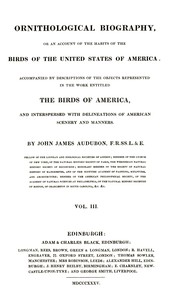
The source record for Ornithological biography, Vol. 3 (of 5) — A Closer Reading measures this digital text at 264,447 words, 19 hr 10 min estimated reading time, and 128 detected text sections.
The text analysis averages about 26.5 words per sentence, while the detected sections provide another way to judge how the source is divided.
Project Gutenberg metadata also associates the work with “Birds -- North America,” connecting these edition facts with the source record’s subject description.
Explore this collection
These alternatives are selected using recorded categories and estimated reading time.
About 1,063 minutes
Birds
244,325 recorded words. 87 minutes difference from this book's estimate.
View Gutenberg source #72279About 1,035 minutes
Birds
237,825 recorded words. 115 minutes difference from this book's estimate.
View Gutenberg source #57191About 902 minutes
Birds
207,341 recorded words. 248 minutes difference from this book's estimate.
View Gutenberg source #56989Search stored excerpts and compare books → Choose by your preferences →
Choices use stored catalog measurements. Estimates vary with reading speed. A shared category is a catalog label, not a claim that two books have the same argument or literary quality.
Search reads excerpt text stored with this catalog and links to its associated Gutenberg record. The connection is stored in the site database; this tool does not recheck that every excerpt is word-for-word identical to that external record. Excerpt search does not cover every chapter and does not verify historical publication dates.
Catalog snapshot checked: 2026-09-26. Coverage: 99 public books, 99 available source excerpts.
Calculated from edition completeness, EPUB availability, text structure and catalogue metadata. Not a user rating.
Total of 100 points, scaled to a 2.5-5.0 range. Editions with an empty description or a missing EPUB file are not scored.
Public-domain source text
The source text is kept in the dedicated reader, separate from this catalogue record and its commentary.
In Volume III of his Ornithological Biography, John James Audubon continues his project of pairing life-size illustrations with detailed life histories of North American birds. The volume is distinguished by a tension between scientific exactitude and the author's personal, often dramatic encounters with his subjects. One of the most striking passages recounts the repeated annual visits of a Great Black-backed Gull to Audubon's garden in Canonmills, Edinburgh—a bird that, after being tamed, would disappear each summer and return each autumn, its arrivals and departures meticulously noted over several years. This anecdote exemplifies Audubon's method: close observation of individual birds over time, combined with a narrative voice that treats each creature as a character with habits and loyalties.
The account of the Great Black-backed Gull occupies several pages and is one of the volume's most sustained narratives. Audubon describes how the bird, initially thought to be a Lesser Black-backed Gull, was kept in his garden, where it became tame enough to follow the servant Peggy Oliver and beg for food. After two molts, its true identity emerged. The gull began a pattern of wintering at Canonmills and departing each spring, returning with remarkable regularity for at least eight years. Audubon records specific dates: arrival on 26 October 1829, departure after a young gull was shot on the loch, and a reappearance on 30 October 1830. The bird's absence in 1832 is noted with disappointment. This narrative reveals Audubon's willingness to invest years in following a single bird's life, and his readiness to infer emotional states—the gull 'reproaching us for cruelty' after the shooting, or 'forgetting the injury' by the next autumn.
The gull story also highlights a recurring tension in Audubon's work: the desire to observe birds closely versus the recognition that they remain wild creatures. The gull was tamed, but its wings were not clipped, and it retained the ability to fly away. Audubon notes that after the death of his protectress in 1828, the gull 'became more distant in his manners.' The bird's comings and goings were voluntary, and its attachment to the garden seemed conditional. When a young gull (likely its offspring) was shot, the old gull abandoned the site for that winter. Yet it returned the following year. This pattern of approach and withdrawal, of trust and caution, mirrors Audubon's own position as a naturalist who must balance intimacy with detachment. The anecdote is not merely charming; it is a case study in the limits of domestication and the persistence of instinct.
Audubon's prose in this volume oscillates between the formal language of natural history and a more personal, almost novelistic style. In the gull account, he includes direct speech from his servant—'Sir, Big Gull is come back!'—and records his own emotional responses: 'I of course gave up all expectation of ever hearing more of it.' These touches lend immediacy but also raise questions about reliability. Audubon is careful to note that the gull's recognition of its old friend the heron was something he was 'firmly persuaded' of, not a proven fact. He also admits that the manner of the gull's first disappearance 'has now escaped my memory.' Such admissions of uncertainty are scattered through the text, suggesting a naturalist aware of the limits of his evidence. The volume thus offers not only data but a portrait of the observer himself—fallible, hopeful, and deeply invested in the lives he chronicles.
Readers approaching this volume will find that Audubon's method rewards patience. The detailed species accounts are interspersed with 'delineations of American scenery and manners,' as the subtitle promises, but the most memorable passages are often those where the author's personal involvement with a single bird or place becomes visible. The gull narrative, in particular, shows how Audubon's ornithology was shaped by long-term acquaintance and a willingness to let the subject dictate the story's pace. To read this volume is to watch a naturalist at work, recording not just facts but the texture of a life spent watching.
I've always treasured that third volume, how the old naturalist let that Great Black-backed Gull settle into his garden year after year, patient as ink drying. It makes me recall the quieter beginnings in Ornithological biography, Vol. 1 (of 5) — Story, Setting & Ideas, where such faithful returns first felt possible. Some friendships simply wait between the pages.
Build a private reading journal entry for this title.