About 69 minutes
Mamma's Stories about Birds — Context and Discussion
Birds
15,835 recorded words. 11 minutes difference from this book's estimate.
View Gutenberg source #24378
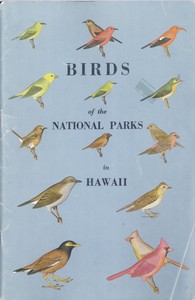
For Birds of the National Parks in Hawaii — A Reader’s Guide, the stored edition analysis reports 13,169 words, 58 min estimated reading time, and 3 detected text sections.
The text analysis averages about 18.4 words per sentence, while the detected sections provide another way to judge how the source is divided.
Project Gutenberg metadata also associates the work with “Birds -- Hawaii,” connecting these edition facts with the source record’s subject description.
Explore this collection
These alternatives are selected using recorded categories and estimated reading time.
About 69 minutes
Birds
15,835 recorded words. 11 minutes difference from this book's estimate.
View Gutenberg source #24378About 69 minutes
Birds
15,727 recorded words. 11 minutes difference from this book's estimate.
View Gutenberg source #62490About 70 minutes
Birds
16,089 recorded words. 12 minutes difference from this book's estimate.
View Gutenberg source #52600Search stored excerpts and compare books → Choose by your preferences →
Choices use stored catalog measurements. Estimates vary with reading speed. A shared category is a catalog label, not a claim that two books have the same argument or literary quality.
Search reads excerpt text stored with this catalog and links to its associated Gutenberg record. The connection is stored in the site database; this tool does not recheck that every excerpt is word-for-word identical to that external record. Excerpt search does not cover every chapter and does not verify historical publication dates.
Catalog snapshot checked: 2026-09-26. Coverage: 99 public books, 99 available source excerpts.
Calculated from edition completeness, EPUB availability, text structure and catalogue metadata. Not a user rating.
Total of 100 points, scaled to a 2.5-5.0 range. Editions with an empty description or a missing EPUB file are not scored.
Public-domain source text
The source text is kept in the dedicated reader, separate from this catalogue record and its commentary.
William W. Dunmire’s Birds of the National Parks in Hawaii (1961) is structured not as a simple checklist but as a guide to where and how to see birds within two specific parks: Hawaii Volcanoes and Haleakala. The booklet moves from an introduction on bird origins and decline to family-by-family accounts, each entry pairing a terse description with a longer narrative on park distribution, voice, and behavior. This dual structure—concise field data followed by informal natural history—reflects the author’s dual role as park naturalist and the reader’s likely dual need: quick identification and deeper understanding of habitat and habit.
Dunmire repeatedly organizes observations around stark habitat contrasts. The omao, for instance, is described as living in two contrasting habitats within Hawaii Volcanoes National Park: dense wet ohia forest and barren lava flows on Mauna Loa. The text notes that on lava flows the bird perches on high rocks, with yellow-green lichen marking old perch sites—a detail that ties behavior to a visible landscape clue. Similarly, the elepaio is said to be common in heavily vegetated areas around Kilauea Crater and at Kipuka Puaulu, but absent from Maui entirely. These habitat-specific notes give the reader a concrete search image: look for omao where ohelo berries grow, or for elepaio in wet fern jungle near the Crater Rim Trail. The structure thus turns park geography into a birding strategy.
Each species account includes a “Voice” section with phonetic renderings that are unusually precise for a mid-century guide. The omao’s calls are given as eéau, prueeé, or a low throaty whuaaá, with the note that these are “likely to be heard before the song.” The elepaio’s vocalizations include a “wolf whistle” (wheé-oo) and a nasal yeékik. These transcriptions, while not scientific, serve as mnemonic devices for the listener. Dunmire also describes the mockingbird’s song as “more varied” than the Chinese thrush, with an emphatic thack. By embedding these sound cues in the text, the guide trains the reader’s ear as much as the eye, a structural choice that acknowledges birds are often heard before seen in dense forest.
The narrative sections go beyond plumage and range to include distinctive behaviors. The elepaio is called “the friendliest of our native birds,” noted for its inquisitive hopping and tail-cocking. It also “pushes its wings forward with a rapid shivering motion” when confronted—interpreted as a possible aggressive action. The omao, by contrast, is described as remaining motionless, often heard first. Its nesting sites long remained an enigma until observers found that lava-flow birds nest in deep horizontal cracks and collapsed lava tubes, while forest birds nest in trees. These behavioral details, drawn from field observation, give the reader a sense of the bird’s life beyond the identification key. They also illustrate how the same species adapts differently to different park habitats.
The guide explicitly links bird sightings to specific trails and drives. For the omao, the Crater Rim Trail between Park Headquarters and Thurston Lava Tube is recommended, as well as the Mauna Loa trail at higher elevations. The elepaio is best looked for at Kipuka Puaulu (Bird Park). Mockingbirds are most likely seen along the lower slopes of Haleakala during the drive up to the crater, with Park Headquarters as the upper limit. These location-specific instructions transform the booklet into a practical itinerary. The reader is not just told what birds exist but where to stand, when to listen, and which path to take. This movement between sites mirrors the bird’s own movements and gives the guide a dynamic, exploratory quality.
Dunmire’s booklet is best read as a companion for a specific visit, not a comprehensive reference. Its value lies in the local knowledge it imparts: which trail yields an elepaio, which lava crack hides an omao nest, which drive offers a mockingbird. The reader who follows these cues will find the birds not as specimens but as inhabitants of a particular landscape. The guide’s structure—moving from habitat to voice to behavior to trail—mirrors the process of learning to see and hear in a new place.
Reading Dunmire’s descriptions of the ʻōmaʻo’s quiet rustle in the kīpuka, I felt that particular ache of place-bound memory—how a bird’s call anchors you to one forest. It reminded me, gently, of leafing through An Introduction to the Birds of Pennsylvania — Reading Companion. Different hills, same hush between notes. Some things simply linger.
Answer a few questions and save a private reflection on this device.