About 769 minutes
Life histories of North American woodpeckers — Story, Setting & Ideas
Birds
176,667 recorded words. 56 minutes difference from this book's estimate.
View Gutenberg source #73940
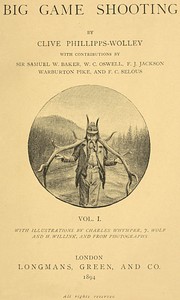
For Big Game Shooting, volume 1 (of 2) — Context and Discussion, the stored edition analysis reports 163,880 words, 11 hr 53 min estimated reading time, and 17 detected text sections.
The text analysis averages about 30.5 words per sentence, while the detected sections provide another way to judge how the source is divided.
Project Gutenberg metadata also associates the work with “Hunting,” connecting these edition facts with the source record’s subject description.
Explore this collection
These alternatives are selected using recorded categories and estimated reading time.
About 769 minutes
Birds
176,667 recorded words. 56 minutes difference from this book's estimate.
View Gutenberg source #73940About 632 minutes
Birds
145,165 recorded words. 81 minutes difference from this book's estimate.
View Gutenberg source #38201About 630 minutes
Birds
144,823 recorded words. 83 minutes difference from this book's estimate.
View Gutenberg source #48816Search stored excerpts and compare books → Choose by your preferences →
Choices use stored catalog measurements. Estimates vary with reading speed. A shared category is a catalog label, not a claim that two books have the same argument or literary quality.
Search reads excerpt text stored with this catalog and links to its associated Gutenberg record. The connection is stored in the site database; this tool does not recheck that every excerpt is word-for-word identical to that external record. Excerpt search does not cover every chapter and does not verify historical publication dates.
Catalog snapshot checked: 2026-09-26. Coverage: 99 public books, 99 available source excerpts.
Calculated from edition completeness, EPUB availability, text structure and catalogue metadata. Not a user rating.
Total of 100 points, scaled to a 2.5-5.0 range. Editions with an empty description or a missing EPUB file are not scored.
Public-domain source text
The source text is kept in the dedicated reader, separate from this catalogue record and its commentary.
The volume begins with a dedication to the Prince of Wales, praising his skill in fox hunting, shooting, and yachting, establishing the aristocratic sporting context of the Badminton Library. The preface states the series' goal: to provide a modern encyclopedia of British sports and pastimes, written by experienced practitioners. This sets expectations for a practical, expert-led guide rather than a mere narrative.
The dedication to the Prince of Wales is not mere formality; it signals the book's intended audience and values. The Duke of Beaufort, editor of the series, personally attests to the Prince's prowess in the field, describing how he "can take a line of his own and live with them better" when hounds run hard. This emphasis on individual skill and dexterity under pressure foreshadows the later technical advice. The preface, meanwhile, acknowledges that "experts often differ," but promises that each contributor is an adept. This candid admission of potential disagreement prepares the reader for a text that may present multiple viewpoints or methods, not a single orthodoxy.
The excerpt on buffalo hunting is dense with specific, actionable warnings. The author stresses the danger of following buffalo into dense bush, where "it is almost impossible to distinguish a beast from its surroundings." The charge of an infuriated buffalo is described as "very difficult to stop" due to its head carriage. A striking detail is the comparison of a charging buffalo to a terrier hunting a rabbit—it will "hunt him" if the first charge misses. The text also notes that old solitary bulls may become nearly deaf, causing them to charge in startled self-defense when approached. This blend of behavioral observation and tactical caution gives the reader a vivid sense of the stakes.
The author insists that a stalker should not attempt buffalo hunting "unless he is properly armed with a heavy rifle." This practical equipment note is paired with environmental factors: the wind in thick covert is "very changeable" and can betray the hunter at the critical moment. Even a successful kill may yield a disappointing trophy—"a cow or a young bull, with a head not worth keeping." The text thus balances the pursuit of an "exceptionally fine trophy" against the real risks and frequent disappointments, urging the sportsman to consider whether the odds are worth it. This pragmatic, risk-assessment tone is characteristic of the volume's instructional approach.
The excerpt includes a specific anecdote: on December 14, 1889, in Turkwel, a buffalo was found lying under a tree within 200 yards of camp, despite 400 porters having been "shouting and yelling" for hours. The story illustrates the buffalo's apparent deafness and the surprise it can cause. Such firsthand accounts lend credibility and break up the instructional passages. They also hint at the broader geographical scope of the volume, which covers hunting in various terrains. The reader should note that these narratives are used to support general principles, not as mere adventure tales.
As you read, pay attention to how the authors balance general rules with specific exceptions—the old deaf bull, the changeable wind, the disappointing trophy. The volume is not a simple how-to but a collection of seasoned judgments. The dedication and preface remind us that this is a book written by and for a particular sporting class, but the technical detail remains accessible to any reader interested in the practical realities of big game hunting in the late 19th century.
This reminded me of an afternoon years ago, tucked away with an old hunting journal, the same tension of being the watcher in dense bush. Yet there is a quieter patience in Ornithological biography, Vol. 1 (of 5) — Story, Setting & Ideas, which let me sit still and observe small flights instead of sudden charges. Both books share a reverence for the wild, but that one felt like listening, not stalking.
Build a private reading journal entry for this title.