The Naturalist's Repository, Volume 1 (of 5) or Monthly Miscellany of Exotic Natural History: etc. etc. — Background and Themes

(0 User reviews)   1574
In Category - Marine Life
Donovan, E. (Edward), 1768-1837 Project Gutenberg 2017 Not confirmed
Zoology -- Pictorial works Readers of public-domain and historical texts
Project Gutenberg digital edition en

Edition facts

Words 48,633
Reading time 212 min
Text sections 39

The source record for The Naturalist's Repository, Volume 1 (of 5) or Monthly Miscellany of Exotic Natural History: etc. etc. — Background and Themes measures this digital text at 48,633 words, 3 hr 32 min estimated reading time, and 39 detected text sections.

The text analysis averages about 27.1 words per sentence, while the detected sections provide another way to judge how the source is divided.

Project Gutenberg metadata also associates the work with “Zoology -- Pictorial works,” connecting these edition facts with the source record’s subject description.

E. Donovan's 1823 volume combines hand-colored plates with precise descriptions of exotic shells, birds, and marine life, revealing 19th-century naturalists' methods of classification and illustration.
Share
Editorial Edition Score 4.9/5

Calculated from edition completeness, EPUB availability, text structure and catalogue metadata. Not a user rating.

How this score is calculated
  • Description quality20 pts
  • Title & short description10 pts
  • Source metadata20 pts
  • Text length15 pts
  • Chapters / structure15 pts
  • EPUB file integrity20 pts

Total of 100 points, scaled to a 2.5-5.0 range. Editions with an empty description or a missing EPUB file are not scored.

Edition quality

Read the Text

the entomological writings of Fabricius have acquired it may be satisfactory to learn that the delineation now before us is copied from the individual specimen which Fabricius had described, and that no other figure of this very interesting Papilio is extant.

The upper surface of the butterfly is of a dark brown colour of peculiar richness, crossed by stripes of deep scarlet. The insect with expanded wings displayed in a flying position in the lower part of the plate exemplifies this aspect of the upper surface. The lower surface is much more beautiful; the marks and colours on the anterior pair possess nearly the same character as those of the upper surface; the posterior pair are very different, being marked with large annular bands of bright yellow upon a fuscous ground, and inclosing a number of distinct spots of cœrulean blue, which in beauty emulate the brilliancy of the finest ultra marine: three of these blue spots are placed in the dark ground upon the disk, the remainder are disposed in a semi-circle upon a band of black towards the posterior extremity of the wings. This appearance is best perceived when the insect appears in a resting position as it is seen on one of the branches of the mimosa in the upper part of the plate.

This insect is a native of Brazil.

PAPILIO PYRAMUS. PYRAMUS BUTTERFLY.

Antennæ thicker towards the tip, and generally terminating in a knob; wings erect when at rest. Fly by day.

SPECIFIC CHARACTER AND SYNONYMS.

Wings entire, fuscous glossed with blue, and marked with a fulvous spot; lower wings beneath grey.

PLEBEJI RURALES, _Fabr. Sp. Ins._

HESPERIA RURALES, _Fabr. Ent. Syst._

PAPILIO PYRAMUS: alis integerrimis fuscis cœruleo micantibus, macula fulva, posticis subtus griseis. _Fabr. Spec. Ins. 2 p. 130. n. 590._—_Mant. Ins. 2 p. 83. n. 755._

HESPERIA PYRAMUS: _Fabr. Ent. Syst. t. 3. p. 1. 323. n. 223._ Alæ omnes fuscæ, cœruleo micantibus: macula magna, in medio fulva. Anticæ, subtus concolores, posticæ griseæ sive cinereo fuscoque variæ. _Fabr._

Fabricius describes Papilio Pyramus as a new species of the genus from the drawings of the late Mr. Jones, of Chelsea, a gentleman of fortune who had long devoted his attention to this peculiar tribe of insects, the Papiliones, and whose labours tended in a very eminent degree to aid those of Fabricius. In return for this assistance, Fabricius affixed to each of those insects the names under which they were destined afterwards to appear before the world, a circumstance that may explain sufficiently the frequent references of the Fabrician writings to those drawings, first in his _Species Insectorum_, and subsequently in his _Entomologia Systematica_. It may be further added, that the whole of these drawings, together with the manuscripts in the hand-writing of Fabricius were long in our own possession, during the life-time of the very amiable proprietor, Mr. Jones, for the very liberal purpose of copying and making known to the public whatever might appear likely to us to promote the interest and advantage of the Science of Nature; and that the insect now before us is one of those very rare species copied for this purpose.

The specimen from which the painting of Mr. Jones was taken formed originally part of the collection of the lamented Mr. Yates, the ingenious author of an English translation of the Linnæan Fundamenta Entomologia, that appeared about forty years ago, and who lost his life by bathing in the river some short time afterwards.

There was a variety of this insect, pretty nearly but not exactly according with this in the collection of an old and well-known entomologist, the late Mr. Drury, a figure of which appeared shortly after the publication of the Fabrician writings as the true Papilio Pyramus. It was not precisely the same as it appeared to us from an inspection of the specimen in the cabinet of Mr. Drury. This insect is to be found represented in the 23rd plate of the third volume of the Exotic Insects of that author, published in the year 1782.

------------------------------------------------------------------------

------------------------------------------------------------------------

VOLUTA SCAPHA var NOBILIS, NOBLE CHINESE VOLUTE.

Animal a limax. Shell uniocellar, spiral; aperture without a beak and sub-effuse: pillar twisted or plaited: generally without lips or perforation.

* Ventricose, spire papillary at the tip, or terminating in an obtuse rounded eminence.

SPECIFIC CHARACTER AND SYNONYMS.

_Var_ NOBLE CHINESE VOLUTE: Shell smooth clouded with zig-zag brown lines, pillar blueish and four plaited: lip subulate.

VOLUTA SCAPHA (var, NOBILIS) testa lævi nebulosa; lineis angularibus fuscis columella caerulescente quadruplicata, labro subulato.

VOLUTA SCAPHA: testa rudi nebulosa: lineis angularibus fuscis columella cærulescente quadruplicata, labro subulato.—_Gmel. Linn. Syst. Nat. t. 1. p. 6. 3468. 121._ _Hist. Conch. t. 799. f. 6._ _Kircher 3. f. 10._ _Bonanni, c. 3. 113. f. 10._ _Klein Ostr. t. 5. f. 94._

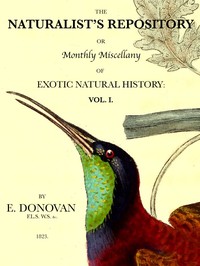
E. Donovan's The Naturalist's Repository opens with a title page that announces its ambition: to present "the most curious, scarce, and beautiful productions of nature" through "elegantly coloured plates" and descriptions. The work is structured as a monthly miscellany, each number introducing a few species with a plate and a detailed account. Donovan, a Fellow of the Linnean Society, writes in a voice that balances scientific rigor with a collector's enthusiasm, often noting the rarity or novelty of a specimen. The excerpts show a consistent pattern: a generic and specific character in Latin, a list of synonyms from earlier naturalists, and then a descriptive paragraph in English that moves from overall form to minute details of color and marking.

Diction and Taxonomic Precision

Donovan's language is carefully calibrated to serve both the specialist and the curious amateur. In describing the Pear Volute (Voluta pyrum), he provides a Latin diagnosis—"testa obovata subcaudati; spiræ anfractibus striatis; apice producto glaberrimo, columella triplicata"—then translates and expands this into English: "Shell obovate and slightly tailed with striated whorls on the spire: tip produced and glabrous: pillar with three plaits." The adjectives are chosen for precision: obovate (egg-shaped with the narrow end downward), striated (marked with fine lines), glabrous (smooth). He does not assume the reader knows these terms; the context makes them clear. When describing the Spotted Pardalote, he uses cinereous brown, fulvous yellow, and testaceous—words that evoke specific hues familiar to naturalists of the period. This lexical specificity is a hallmark of the work.

Dialogue with Earlier Authorities

Donovan frequently situates his descriptions within the broader conversation of natural history. For the Voluta, he cites Gmelin, Linnæus, Lister, Bonanni, Knorr, Gualtieri, Martini, and Chemnitz—a roll call of 18th-century conchologists. He does not merely list them; he engages critically. In the same entry, he questions Linnæus's broad use of the term Limax for the animal inhabitants of many univalve genera, noting that "it could scarcely be conceived that in the very ample range of the creation which those genera embraced, such uniformity could prevail." This shows Donovan as a participant in an evolving science, not a passive compiler. He acknowledges that discoveries since Linnæus have expanded knowledge, and he positions his own work as part of that progress. The reader is thus invited to see each plate as a contribution to an ongoing debate.

Structure of a Plate Entry

Each plate chapter follows a predictable but effective structure. It begins with a heading naming the species (e.g., "PLATE XXI. VOLUTA PYRUM PEAR VOLUTE"), followed by a generic character in Latin, then the specific character and a list of synonyms. The descriptive text then proceeds in paragraphs that move from the general to the particular. For the Spotted Pardalote, Donovan first gives its size ("about four inches") and compares it to the common willow-wren, then describes the plumage region by region: above, throat and breast, crown, wings, rump, tail, and finally bill and legs. This systematic approach ensures completeness and makes the description easy to follow. He also notes variation—"though not invariably, there is a white dot at the tip of each of the tail feathers"—indicating an awareness of individual differences. The entry often closes with a note on the plant depicted in the background, linking the animal to its habitat.

The Role of the Plate

The plates are not mere illustrations; they are integral to Donovan's project. The title page emphasizes "elegantly coloured plates," and the descriptions refer to them explicitly: "as represented in the plate annexed." For the Pardalote, the plate shows the bird "perched upon a sprig of the ovate leaved Goodenia" that flowered at Kew Gardens in July 1822—a detail that grounds the image in a specific time and place. Donovan uses the plate to convey information that words alone cannot, such as the exact arrangement of spots and the gradation of colors. The transcriber's notes reveal that plates 19 and 20 were originally reversed and had to be swapped, and that a missing title for Plate VI was added—indicating the care taken to ensure that text and image align. For the reader, the plate is the primary evidence; the text is its explication.

Donovan's Repository rewards a slow, comparative reading. Notice how he handles variation within a species, how he cites earlier authors, and how he moves from Latin diagnosis to English description. The work is best approached not as a reference to be dipped into, but as a serial publication that builds a picture of early 19th-century natural history in action. Each entry is a miniature essay on a single organism, and the cumulative effect is a vivid portrait of a scientific community at work.

Donovan’s Repository sorted exotic shells by careful plates, yet the wonder in his hand never left my room. Years later, I found The Common Objects of the Country — Background and Themes, and there it was again, that same tender gaze—not at strange birds, but at familiar hedgerow leaves, quietly cherished. Both books simply loved looking closely.

There are no reviews for this eBook.

0
0 out of 5 (0 User reviews )

Add a Review

Your Rating *
There are no comments for this eBook.

Reader reflection

How will you remember this book?

Save your reaction, strongest insight, and memorable passage.

Your progress 0 / 10
1

What is your current status with this title?

2

How much did you enjoy the reading experience?

3

Would you recommend this book to another reader?

4

How demanding did the text feel?

Related eBooks