About 59 minutes
Humpback Whales in Glacier Bay National Monument, Alaska — Text and Context
Marine Life
13,509 recorded words. 0 minutes difference from this book's estimate.
View Gutenberg source #37101
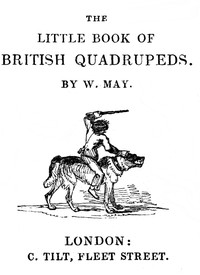
Before opening The little book of British quadrupeds — Background and Themes, the edition data offers a quick orientation: 13,555 words, 59 min estimated reading time, and 49 detected text sections.
The text analysis averages about 23.4 words per sentence, while the detected sections provide another way to judge how the source is divided.
Project Gutenberg metadata also associates the work with “Mammals -- Great Britain -- Juvenile literature,” connecting these edition facts with the source record’s subject description.
Explore this collection
These alternatives are selected using recorded categories and estimated reading time.
About 59 minutes
Marine Life
13,509 recorded words. 0 minutes difference from this book's estimate.
View Gutenberg source #37101About 86 minutes
Marine Life
19,677 recorded words. 27 minutes difference from this book's estimate.
View Gutenberg source #61973About 116 minutes
Marine Life
26,473 recorded words. 57 minutes difference from this book's estimate.
View Gutenberg source #34787Search stored excerpts and compare books → Choose by your preferences →
Choices use stored catalog measurements. Estimates vary with reading speed. A shared category is a catalog label, not a claim that two books have the same argument or literary quality.
Search reads excerpt text stored with this catalog and links to its associated Gutenberg record. The connection is stored in the site database; this tool does not recheck that every excerpt is word-for-word identical to that external record. Excerpt search does not cover every chapter and does not verify historical publication dates.
Catalog snapshot checked: 2026-09-26. Coverage: 99 public books, 99 available source excerpts.
Calculated from edition completeness, EPUB availability, text structure and catalogue metadata. Not a user rating.
Total of 100 points, scaled to a 2.5-5.0 range. Editions with an empty description or a missing EPUB file are not scored.
Public-domain source text
The source text is kept in the dedicated reader, separate from this catalogue record and its commentary.
W. May's The Little Book of British Quadrupeds, published in 1835, opens with a description of the Kyloe Ox that is brisk and utilitarian: the animal is black, thick-hided, and every part is put to use—hide into leather, horns into knife-handles, bones as a substitute for ivory. This matter-of-fact tone, focused on economic utility, sets the stage for a work that gradually reveals a more varied voice. As the entries progress, the language shifts: the Horse is introduced as 'noble,' and the narrative expands into a sustained anecdote about a horse's memory, a story that occupies several paragraphs. This change in pace—from compressed fact to leisurely tale—marks a distinctive feature of May's approach, blending instruction with entertainment.
The early entries, such as those on the Kyloe Ox and the Cow, are stripped to essentials: colour, size, uses. The prose is almost list-like, with short sentences and a focus on practical applications. But by the time May reaches the Horse, the rhythm alters. The description of the horse's memory is not a dry fact but a small story: a gentleman, lost in the dark, trusts his horse to find the way home, and the animal succeeds. This anecdote occupies far more space than the preceding entries, suggesting a deliberate choice to engage young readers through narrative. The shift is not merely stylistic; it implies that some animals merit a fuller, more personal treatment, while others are dealt with summarily.
May's voice becomes notably patriotic in the sections on dogs. The Foxhound, he writes, is unmatched in Europe, and 'the utmost attention is paid to their training' in Great Britain. He adds that 'attachment to the chase has been considered a trait in the national character.' This rhetorical flourish is absent from the earlier, more neutral entries. The language here is evaluative, even boastful, and the sentences grow longer, building a case for British pre-eminence. The anecdote of the two hounds that die after pursuing a stag to exhaustion reinforces this tone: the dogs' loyalty and stamina are presented as admirable, almost heroic. May's voice thus moves from detached observer to invested commentator, a shift that colours the latter half of the book.
The entries vary markedly in length and tempo. The Kyloe Ox is dispatched in a few lines; the Horse stretches over several paragraphs; the Foxhound includes a dramatic death scene. This uneven pacing suggests that May is not simply cataloguing species but selecting moments for emphasis. The Harrier entry, for instance, includes a brief crime story: a bloodhound leads to a hidden sheep carcass. Such tales break the monotony of description and serve as mnemonic devices. They also hint at a moral dimension—the horse's fidelity, the hound's perseverance—that is only implicit in the earlier, more functional entries. Readers attentive to these shifts will find a book that teaches not only facts but also values through its variable narrative speed.
May's book rewards a reading that attends to its changes in pace and voice. The early entries, brisk and utilitarian, give way to longer, more anecdotal passages that celebrate certain animals and, by extension, British virtues. This variation is not accidental; it shapes the reader's experience, making the work more than a simple list. To appreciate The Little Book of British Quadrupeds, follow the rhythm of its prose and note where the author lingers—those are the places where instruction becomes story.
In The Little Book of British Quadrupeds, Mr. May’s fondness creeps past his dry factual lines, especially with the old hunting dogs. That quiet warmth—the way a careful observer’s affection reshapes plain words—reminds me of another patient chronicler, one gazing at leviathans breaching in an Alaskan fjord. Their kinship is a shared tenderness for creatures simply going about their lives. Humpback Whales in Glacier Bay National Monument, Alaska — Text and Context holds that same gentle reverence.
Your answers remain private and are stored only in this browser.