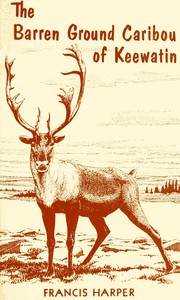
The Barren Ground Caribou of Keewatin — Inside the Classic
Edition facts
For The Barren Ground Caribou of Keewatin — Inside the Classic, the stored edition analysis reports 61,932 words, 4 hr 30 min estimated reading time, and 10 detected text sections.
The text analysis averages about 16.5 words per sentence, while the detected sections provide another way to judge how the source is divided.
Project Gutenberg metadata also associates the work with “Barren ground caribou,” connecting these edition facts with the source record’s subject description.
Calculated from edition completeness, EPUB availability, text structure and catalogue metadata. Not a user rating.
How this score is calculated
- Description quality20 pts
- Title & short description10 pts
- Source metadata20 pts
- Text length15 pts
- Chapters / structure15 pts
- EPUB file integrity20 pts
Total of 100 points, scaled to a 2.5-5.0 range. Editions with an empty description or a missing EPUB file are not scored.
Read the Text
3°), a lull ensued in the movements of the Caribou.
The big movement of the fall migration finally began to materialize on Sunday, August 24. This and the next few days were filled with memorable experiences. The throngs of Caribou passing at such times around the head of Windy Bay and across the lowermost portions of Little and Windy rivers may be accounted for, in part, by the local topography (map 1). The upper part of Windy Bay, occupied by numerous islands of various sizes and extending about 5 miles in an east-west direction, opposes something of a barrier to the Caribou in their southward trek. The easiest way to overcome this barrier is to by-pass it. So the migrant herds approaching the north shore of the bay turn westward toward Little River. At a point half a mile short of this stream a rather minor proportion of the Caribou actually do essay a passage of Windy Bay. They cross an island lying very close to the north shore, then steer for a small rocky islet a quarter of a mile northwest of the mouth of South Bay. Here they get a brief respite from swimming by walking through the shallow bordering waters, then continue straight on to the rugged south shore of Windy Bay. This course is roughly parallel to, and a quarter of a mile west of, the one pursued northward or northeastward across the ice in the spring migration. The Caribou were seen to follow this water route on various days from August 24 to September 8, and again on October 7. Like the one across the ice, it is probably a regular, well-established, annual route.
The greater number of the migrants proceed along the north shore of the bay to Little River and are there confronted with a choice of various further routes. Some continue for an indefinite distance up the northeastern bank, passing Lake Charles on their right, though other animals, coming from the north, may be following this bank in the opposite direction. Probably most of the Caribou arriving from the eastward either plunge into Little River at its mouth and swim across (figs. 9, 10, 12) or pass upstream for a bare quarter of a mile and then wade across at a rapid (figs. 7, 8).
Without human interference, a large proportion of those that cross the lower part of Little River would doubtless proceed more or less directly to Windy River and cross near its mouth. But the human and canine inhabitants of the Windy River post seem to exert a strong influence in deflecting the Caribou northwestward along several more or less parallel ridges that rise to a maximum height of 40 or 50 feet. These are Little River, Middle, and Camp ridges (map 1). Many animals follow the first of these to its northwestern end, then cross a bog and ascend the Middle Ridge. Some cross the southeastern end of Little River Ridge, scramble down its steep sides by strongly marked trails (fig. 2), and then move across the Eastern Bog to the Middle Ridge. But when they reach the summit, they can see the post directly ahead, and generally hurry off northwestward along the ridge. Presently some may cross the Camp Slough (fig. 13) to the Camp Ridge and then proceed either westward or northwestward. The Caribou have a strong predilection for following the treeless summits of the ridges wherever they are available and extend in a more or less desirable direction. On reaching the vicinity of the Bear Slough, where the three ridges are interrupted or peter out, the animals doubtless turn more or less southwestward to make a passage of Windy River at various points above its mouth. Under the conditions outlined above, it is obvious that some of the finest opportunities for close-range observation and photography lie at the two well-established crossings near the mouth of Little River.
Francis Harper's The Barren Ground Caribou of Keewatin (1955) opens a window onto the lives of caribou through a lens that is at once scientific and sensory. The text moves between meticulous measurements—tracks 'approximately 4 inches long and 4½ inches wide'—and evocative glimpses of animals in motion: the 'white spats' above the hoofs that 'fairly twinkle' during a trot. Harper's voice is that of a naturalist who records both the weight of antlers and the 'rare charm' of a caribou stepping across a shallow rapid.
A Scientist's Eye for Detail
Harper's prose is anchored in precise observation. He notes that a buck's antlers are 'of such weight as apparently to force it to hold its head rather rigidly while going at speed,' a detail that connects anatomy to gait. The text is dense with measurements: tracks in mud, the superimposition of hind foot on front foot in walking, and the dimensions of hoofs drawn by Seton. Yet these numbers never feel dry; they serve to ground the reader in the physical reality of the animal. Harper also records variability—a limping caribou, a fawn that leaps 'into the air before settling down to a trot'—reminding us that each observation is a single data point in a living system.
Pace and Rhythm in the Field
The narrative itself enacts the rhythms it describes. Short, declarative sentences—'Every now and then a Caribou will be seen limping'—alternate with longer, flowing passages that mirror the caribou's own gait. When Harper writes of 'the rhythmic splashings of the water to the front and the sides of the alternately descending hoofs,' the sentence slows, inviting the reader to hear the scene. This variation in pace is not merely stylistic; it reflects the naturalist's dual attention to the steady accumulation of data and the sudden, vivid moment of encounter. The shift from measured description to lyrical observation—as when alarmed caribou 'make great splashing leaps into a river or bay, fairly enveloping themselves in huge clouds of spray'—marks a change in tempo that echoes the animal's own transition from calm to flight.
Voice Between the Lines
Harper's voice is that of a participant-observer, present in the landscape but rarely foregrounded. He uses the first person sparingly—'I have seen several of the animals running with open mouths'—and when he does, it is to anchor a claim in direct experience. The text is also a conversation with other naturalists: references to Lyon, Seton, and Banfield appear in parentheses, creating a scholarly chorus. Yet the most striking moments are those where Harper lets the caribou take center stage, as in the description of a fawn that 'started off twice in succession, and each time with an initial leap into the air.' The scientist steps back, and the animal's behavior becomes the focus. This restraint gives the prose authority without ego.
The Texture of the Land
Though Harper's primary subject is the caribou, the Keewatin landscape emerges through incidental details: mud that holds a track, snow that records a footfall, water that 'splashes' and 'sprays.' The environment is not described for its own sake but as the medium through which the caribou moves. Trails 'resulting from the impact of countless hoofs on the same restricted courses for unnumbered years' speak to a deep time of animal passage. Harper's attention to the physical traces—the print, the gait, the leap—makes the land itself a character, shaped by and shaping the caribou's journey.
Readers will find that Harper's monograph rewards attention to its shifts in register: the dry catalog of measurements gives way to passages of quiet beauty, and the scholarly apparatus (references, tables) frames a narrative that is as much about the act of watching as about the animal watched. The book is best approached not as a field guide but as a record of sustained attention—a scientist's patient, wondering eye turned on a creature in motion.
Reading Harper’s account of the caribou’s ceaseless tread, I remembered watching a lone fox cross a frosted field as a child—how its measured pace felt eternal, unhurried. That same patience surfaces in The little book of British quadrupeds — Background and Themes, where each small creature’s habits feel like quiet anchors, turning observation into tenderness. There, too, I found that gentle wonder.
There are no reviews for this eBook.
Your personal reading reflection
Build a private reading journal entry for this title.