About 211 minutes
Illustrations of Exotic Entomology, Volume 2 — Key Ideas to Explore
Insects
48,442 recorded words. 10 minutes difference from this book's estimate.
View Gutenberg source #47600
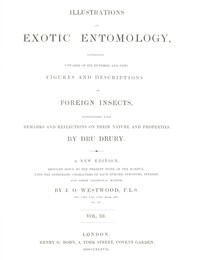
The catalog record for Illustrations of Exotic Entomology, Volume 3 — Story, Setting & Ideas provides practical reading context through 46,004 words, 3 hr 21 min estimated reading time, and 17 detected text sections.
The text analysis averages about 10.5 words per sentence, while the detected sections provide another way to judge how the source is divided.
Project Gutenberg metadata also associates the work with “Insects -- Pictorial works,” connecting these edition facts with the source record’s subject description.
Explore this collection
These alternatives are selected using recorded categories and estimated reading time.
About 211 minutes
Insects
48,442 recorded words. 10 minutes difference from this book's estimate.
View Gutenberg source #47600About 172 minutes
Insects
39,457 recorded words. 29 minutes difference from this book's estimate.
View Gutenberg source #44096About 263 minutes
Insects
60,418 recorded words. 62 minutes difference from this book's estimate.
View Gutenberg source #45812Search stored excerpts and compare books → Choose by your preferences →
Choices use stored catalog measurements. Estimates vary with reading speed. A shared category is a catalog label, not a claim that two books have the same argument or literary quality.
Search reads excerpt text stored with this catalog and links to its associated Gutenberg record. The connection is stored in the site database; this tool does not recheck that every excerpt is word-for-word identical to that external record. Excerpt search does not cover every chapter and does not verify historical publication dates.
Catalog snapshot checked: 2026-09-26. Coverage: 99 public books, 99 available source excerpts.
Calculated from edition completeness, EPUB availability, text structure and catalogue metadata. Not a user rating.
Total of 100 points, scaled to a 2.5-5.0 range. Editions with an empty description or a missing EPUB file are not scored.
Public-domain source text
The source text is kept in the dedicated reader, separate from this catalogue record and its commentary.
Dru Drury's Illustrations of Exotic Entomology, Volume 3 is organized as a systematic catalogue of foreign insects, each entry pairing a hand-colored plate with a detailed description. The work's structure moves from a general preface to individual species accounts, where a consistent pattern emerges: each description begins with the upper side of the insect, then the under side, followed by taxonomic synonyms and habitat. This binary division—upper versus under—creates a rhythmic alternation that mirrors the act of turning a specimen over for examination.
Nearly every species entry in this volume is split into two distinct sections: “Upper Side” and “Under Side.” This repeated binary structure imposes a disciplined observational order. For instance, in Nymphalis Iole, the upper side is described as “brown-black, a considerable part of them encircling the body being dark orange,” while the under side shifts to “brown, having a blueish as well as a reddish hue.” The contrast is not merely visual but textual—the under side often introduces new colors (cream, grey) and patterns (waved lines, white spots) absent above. This structural choice emphasizes that a complete understanding of an insect requires viewing it from multiple perspectives, a lesson in careful looking.
Across the excerpts, certain descriptive elements recur with striking frequency. Spots appear in nearly every entry: “square black spot,” “two very small ones,” “five small white spots,” “round black spot encircled with yellow.” Bands and borders are equally common: “white band,” “black border,” “row of white spots.” These recurring motifs create a visual vocabulary that links disparate species. The descriptions often quantify these features precisely—“two narrow faint reddish longitudinal streaks” or “a row of white spots thereon”—suggesting that Drury and Westwood aimed for a standardized, almost formulaic mode of observation. This repetition also hints at the limitations of language: the same terms are reused because the insects themselves share similar patterns.
The text frequently gestures toward the plates, as in “Plate XXXVIII, fig. 2,” but the descriptions themselves are not mere captions. They guide the reader’s eye across the insect’s body in a deliberate sequence: from antennae to eyes, thorax, abdomen, then wings. This top-to-bottom, front-to-back movement mimics the act of examining a pinned specimen. Yet the plates are not referenced in the body of the description; instead, the text stands alone as a verbal diagram. The relationship between word and image is complementary but not redundant—the description supplies details (like “two small white spots on the neck”) that the plate may not clearly show, while the plate provides color and form that words can only approximate.
J. O. Westwood’s editorial role is evident in the systematic headings added to each entry: Order, Section, Family, Genus, and synonyms. These taxonomic labels impose a Linnaean framework on Drury’s original descriptions, which were more loosely organized. For example, Heliconia Sappho is placed in the family Heliconiidæ, a classification that postdates Drury’s first edition. Westwood also includes Latin diagnoses and references to Fabricius, Cramer, and other authors. This layering of historical and contemporary taxonomy creates a palimpsest effect: the reader sees both Drury’s 18th-century observations and Westwood’s 19th-century science. The result is a volume that documents not only exotic insects but also the evolving practice of entomology itself.
Readers approaching this volume should attend to the interplay between the upper and under side descriptions, noting how the same insect can appear dramatically different when viewed from below. The recurring visual motifs—spots, bands, borders—reward comparative reading across entries. Westwood’s taxonomic additions provide a useful framework, but Drury’s original voice, with its careful attention to minute details, remains the heart of the work. Treat the plates and text as complementary records of a single specimen, each incomplete without the other.
Reading Drury’s careful notes about moving a specimen from pin to plate, I remembered how quietly companionable such precision can feel. It’s like watching someone close a cabinet door after coaxing a moth into light. That same gentle patience lingers in Insect Adventures — Reading Companion, where observation becomes a kind of friendship, unhurried and soft.
Answer a few questions and save a private reflection on this device.