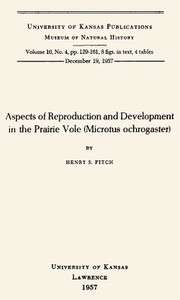
Aspects of Reproduction and Development in the Prairie Vole (Microtus ochrogaster) — Text and Context

(0 User reviews)   1914
In Category - Insects
Fitch, Henry S. (Henry Sheldon), 1909-2009 Project Gutenberg 2011 Not confirmed
Microtus; Voles; Prairie vole Readers of public-domain and historical texts
Project Gutenberg digital edition en

Edition facts

Words 14,918
Reading time 65 min
Text sections 5

The source record for Aspects of Reproduction and Development in the Prairie Vole (Microtus ochrogaster) — Text and Context measures this digital text at 14,918 words, 1 hr 5 min estimated reading time, and 5 detected text sections.

The text analysis averages about 14.5 words per sentence, while the detected sections provide another way to judge how the source is divided.

Project Gutenberg metadata also associates the work with “Microtus,” connecting these edition facts with the source record’s subject description.

Henry S. Fitch's 1957 monograph analyzes four years of live-trapping data on prairie voles, detailing reproduction, growth, and early development with precise observations on litter competition, weight fluctuations, and behavioral milestones.
Share
Editorial Edition Score 4.5/5

Calculated from edition completeness, EPUB availability, text structure and catalogue metadata. Not a user rating.

How this score is calculated
  • Description quality20 pts
  • Title & short description10 pts
  • Source metadata20 pts
  • Text length15 pts
  • Chapters / structure15 pts
  • EPUB file integrity20 pts

Total of 100 points, scaled to a 2.5-5.0 range. Editions with an empty description or a missing EPUB file are not scored.

Edition quality

Read the Text

Measurements were recorded along with other data in the field at the point of capture. Obtaining a reasonably accurate measurement on a live and struggling vole required patience and practice. With the thumb and forefinger of the left hand, I grasped the vole by loose skin of the nape, and simultaneously grasped the tail at a point approximately three-fourths of the distance to the tip. Then, with gentle but steady pressure, I stretched the vole out to its full length, meanwhile manipulating a millimeter ruler with the free fingers, so that the vole was pressed against it, with the nose pad at the end of the ruler.

The total length measurement is considered the best index to over-all size. The relative tail-length varies slightly between individuals, averaging approximately 22 per cent of the total length. Individuals having broken tails, or having the distal parts of their tails missing, were not included. The total length can be measured with greater accuracy than can either the head-and-body length or the tail-length separately.

GENERAL SOCIAL BEHAVIOR

As compared with other mammals, voles are tolerant and somewhat social. That individuals are not mutually exclusive (territorially) in areas occupied was demonstrated on many occasions when more than one individual was caught simultaneously in the same live-trap. Injury of a vole by a trap-mate was a rare occurrence.

Multiple captures often involved a female in oestrus and one or more males, or a female and her young, but other instances involved various combinations of sex and age groups. As many as five adults have been caught in a trap simultaneously at times when the population density was high. At such times, the meadow habitat is crossed by a maze of interconnecting surface runways and one runway may be traced continuously for 100 yards or more. Because each individual vole normally confines its activity to a small area, only a fraction of an acre, it is evident that individuals living at different places overlap in their home ranges, and also in the trailways followed in foraging. A high degree of tolerance is indicated. Where population is so sparse that the systems of surface runways comprise separate and isolated units, trapping experience has shown that one such system may harbor several or many individuals.

As direct observations on voles under natural conditions are rarely feasible, because of the animals' timidity, their utilization of concealing cover, and tendency to crepuscular habits, best evidence of social habits and underground life is based upon behavior of captive individuals. Many voles were kept in confinement for varying lengths of times, either singly or in association with others. Under such conditions there was sometimes sporadic fighting, but it was mainly defensive and serious injuries were rare. Two or more voles caught at a given spot regardless of whether they were found in the same trap simultaneously, or trapped separately within a short time, usually were completely tolerant of each other. When at rest in their container, such voles would huddle together in a corner or in a nest, if materials were provided, so that collectively they presented the minimum exposed surface. The intimacy and lack of antagonism displayed on such occasions, suggested that the voles were accustomed to living together amicably in the same nest chamber. In live-trapping, "double" captures in a single trap often involved the same two individuals. Such trap-mates were often male and female, and in many instances the female was not in breeding condition. That the voles are not monogamous in habits was demonstrated when the same female was often trapped in association with either of two males. Other trap associates taken together repeatedly often were two males, or two females. Voles that are nest mates or "neighbors" may tend to move about together in their foraging, or one confined in a trap may attract the other sufficiently to cause it to force an entrance by lifting the heavy door of a trap.

Henry S. Fitch's 1957 monograph, published as part of the University of Kansas Museum of Natural History series, draws on an unusually large dataset: over 3,550 voles captured and recorded 14,750 times across a four-year period on the University of Kansas Natural History Reservation. The study focuses on reproduction and development, using live-trapping grids at 50-foot and 20-foot intervals to track marked individuals. Fitch's prose is direct and observational, favoring quantified descriptions—such as noting that the prairie vole is 'by far the most abundant mammal' on the Reservation—over interpretive commentary.

Diction and the Language of Measurement

Fitch's vocabulary is consistently technical but not opaque. He describes newborn voles with clinical precision: 'the skin is pinkish gray dorsally and pink ventrally,' with 'sparse and exceedingly fine hairs less than 1 mm. in length.' Such measurements recur throughout, anchoring observations to physical scales. The author avoids anthropomorphic language; even when noting that young 'make faint squeaking sounds,' the phrase is presented as a neutral behavioral datum. This lexical restraint extends to his treatment of mortality—competition for teats is described as 'intense,' but the word carries no emotional weight. The effect is a tone of detached expertise, where the vole's biology is rendered through numbers and anatomical detail rather than narrative.

Voice and the Role of the Observer

Fitch's authorial voice is that of a field biologist reporting from direct experience. He uses first-person plural sparingly ('we have dealt with some topics') but primarily writes in the passive or third person, as in 'young were successfully transferred.' The observer is present but unobtrusive: when describing how young 'would follow any larger individual indiscriminately,' the statement arises from repeated observation, not speculation. Fitch also acknowledges the limits of his data, calling the report 'a preliminary attempt to analyze, in part, these extensive data.' This cautious framing reinforces the scientific credibility of the work, positioning the author as a careful interpreter rather than a definitive authority.

Structure and the Chronology of Development

The monograph's structure mirrors its subject's life cycle. After an introduction detailing trapping methods and study area, Fitch organizes findings into sections on reproduction, early development, and growth. The development section follows a strict day-by-day sequence: 'One day old: Little changed… Two days old: Covering of fine brown hair… Four days old: Pale brown hair averaging about 1 mm.' This chronological framework allows readers to track physical and behavioral changes with precision. Each entry includes specific milestones—incisor eruption at two days, eye-opening at nine to ten days, weaning around seventeen days—creating a clear developmental timeline. The structure itself becomes a tool for understanding vole biology, emphasizing the rapid, measurable progression from helpless neonate to independent juvenile.

Recurring Details: Competition and Survival

A striking pattern in Fitch's observations is the emphasis on competition among littermates. He notes that 'in litters with more than four young, there is competition for the inguinal teats' and that 'it is doubtful whether more than four young to a litter are ever able to survive.' This detail recurs in descriptions of feeding behavior: 'when litters in confinement were fed with fresh greens, there was nearly always quarrelsome squeaking and scuffling.' The author does not moralize or generalize, but the repeated mention of competition underscores its role in vole population dynamics. Similarly, Fitch records that young 'would follow any larger individual indiscriminately' and 'would huddle against it or nuzzle its undersurface searching for a teat,' highlighting the vulnerability of neonates. These recurring observations build a picture of a species shaped by intense early-life selection.

Fitch's monograph rewards readers who attend to its quantitative details. The day-by-day development notes, the precise measurements of fur and teeth, and the repeated observations of litter competition all contribute to a dense, evidence-based portrait of prairie vole biology. Readers interested in field methodology will find the trapping grid descriptions instructive, while those focused on life history will appreciate the clear chronological structure. The work stands as a model of concise, data-driven natural history writing.

Reading Fitch’s patient tracking of vole litters, I recalled the long summer I spent flipping through An Introduction to Entomology: Vol. 4 or Elements of the Natural History of the Insects — Background and Themes, feeling the same quiet awe at how much tiny, hidden lives demand of us just to be witnessed. Both books felt like listening to someone breathe.

There are no reviews for this eBook.

0
0 out of 5 (0 User reviews )

Add a Review

Your Rating *
There are no comments for this eBook.

Reader reflection

Record your reading impressions

A brief reflection can help important ideas stay with you longer.

Your progress 0 / 10
1

Have you finished this book?

2

How much did you enjoy the reading experience?

3

Would you recommend this book to another reader?

4

How demanding did the text feel?

Related eBooks