About 201 minutes
Illustrations of Exotic Entomology, Volume 3 — Story, Setting & Ideas
Insects
46,004 recorded words. 10 minutes difference from this book's estimate.
View Gutenberg source #47601
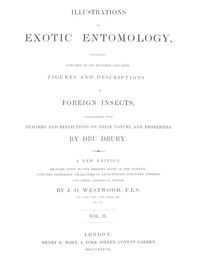
The catalog record for Illustrations of Exotic Entomology, Volume 2 — Key Ideas to Explore provides practical reading context through 48,442 words, 3 hr 31 min estimated reading time, and 10 detected text sections.
The text analysis averages about 13.7 words per sentence, while the detected sections provide another way to judge how the source is divided.
Project Gutenberg metadata also associates the work with “Insects -- Pictorial works,” connecting these edition facts with the source record’s subject description.
Explore this collection
These alternatives are selected using recorded categories and estimated reading time.
About 201 minutes
Insects
46,004 recorded words. 10 minutes difference from this book's estimate.
View Gutenberg source #47601About 172 minutes
Insects
39,457 recorded words. 39 minutes difference from this book's estimate.
View Gutenberg source #44096About 263 minutes
Insects
60,418 recorded words. 52 minutes difference from this book's estimate.
View Gutenberg source #45812Search stored excerpts and compare books → Choose by your preferences →
Choices use stored catalog measurements. Estimates vary with reading speed. A shared category is a catalog label, not a claim that two books have the same argument or literary quality.
Search reads excerpt text stored with this catalog and links to its associated Gutenberg record. The connection is stored in the site database; this tool does not recheck that every excerpt is word-for-word identical to that external record. Excerpt search does not cover every chapter and does not verify historical publication dates.
Catalog snapshot checked: 2026-09-26. Coverage: 99 public books, 99 available source excerpts.
Calculated from edition completeness, EPUB availability, text structure and catalogue metadata. Not a user rating.
Total of 100 points, scaled to a 2.5-5.0 range. Editions with an empty description or a missing EPUB file are not scored.
Public-domain source text
The source text is kept in the dedicated reader, separate from this catalogue record and its commentary.
Dru Drury's preface to the second volume of Illustrations of Exotic Entomology (1837) is an unusually candid document. Rather than a straightforward scientific introduction, Drury explains that the work's continuation depended on public sales—the 'quick sale of a great number of copies' justified the expense of engraving and coloring plates. This commercial framing sits alongside a stated desire to 'lead the mind to the exercise of one of its noblest faculties' through natural history. The volume thus presents itself as both a luxury object and a contribution to Enlightenment science.
The edition, updated by J. O. Westwood, integrates Linnaean taxonomy, synonyms, and habitat data. Entries follow a consistent structure: Latin diagnosis, English description of upper and under sides, and occasional natural history notes. The result is a work that balances aesthetic appeal with systematic rigor, inviting readers to move between plate and text.
Drury's preface offers a rare glimpse into the economics of eighteenth-century natural history publishing. He writes that he needed 'some proof of the public approbation, before I ventured rashly to engage further in so considerable an expense.' The success of the first volume—measured by sales—directly enabled the second. This transparency about financial risk is unusual in scientific prefaces of the period.
Yet Drury also frames his work as a moral and intellectual endeavor, aiming to 'gratify a laudable curiosity' and induce contemplation of 'the admirable works of Providence.' The preface thus reveals a tension between commerce and piety that shaped many natural history projects. Readers encountering the volume for the first time may find this opening a useful key to understanding the author's dual motivations.
Each species description follows a predictable pattern, making the volume easy to navigate. The entry for Deilephila nessus (Plate XXVII) exemplifies this: a Latin diagnosis, a list of synonyms (including references to Cramer and Fabricius), a habitat note ('Madras'), and then a detailed English description divided into 'Upper Side' and 'Under Side.' Colors are specified with precision—'ash-coloured,' 'golden yellow,' 'cream-coloured'—reflecting the importance of accurate hand-coloring in the plates.
The descriptions are purely morphological, with no speculation about behavior or ecology. However, some entries, like that of Glaucopis coarctata, include a question mark after the section heading ('Crepuscularia?'), indicating taxonomic uncertainty. This honesty about gaps in knowledge is a hallmark of the work's scientific integrity.
Although most entries are limited to physical description, a few include observations on life history. The account of Sphinx prini (not in the excerpt but referenced) notes that its caterpillar feeds on 'evergreen winter-berry' and describes its color: 'pale green, with six lateral oblique pink lines.' The text also records the duration of the pupal stage—one individual emerged after 33 days, another after eight months—and mentions parasitism by a small ichneumon wasp.
These details are attributed to the naturalist Abbot, whose field observations supplement Drury's own. The inclusion of such data, though sporadic, enriches the volume beyond a mere catalog of specimens. It connects the preserved insects to living organisms with specific behaviors and ecological relationships.
The volume covers insects from diverse regions, including Madras, the Bay of Honduras, and 'America meridionali.' This geographic breadth reflects the global reach of colonial natural history. The taxonomic range is also wide: the excerpt includes a sphingid moth (Deilephila nessus) and a possible aegeriid (Glaucopis coarctata), illustrating the editors' attempt to classify within the Linnaean system.
Westwood's updates add synonyms and references to contemporary works, such as Fabricius's Entomologia Systematica. The result is a text that functions both as a standalone reference and as a bridge to the broader entomological literature of the early nineteenth century. Readers interested in the history of classification will find these layers of citation revealing.
This volume rewards a sequential reading: start with the preface to understand Drury's aims, then examine a few entries in detail to grasp the descriptive conventions. Pay attention to the footnoted synonyms and habitat notes, which connect the work to a wider network of collectors and taxonomists. The plates, though not reproduced here, are essential companions—the text was designed to be read alongside them. For a fuller picture, consult Volumes I and III of the series, also available from Project Gutenberg.
That rainy afternoon, Drury’s hand-colored plates made me linger on each wing’s faint geography—Madras, Honduras—until I noticed how the British species in Butterflies and Moths (British) — Text and Context carried the same quiet exactness, though closer to home. The rain softened, and I simply turned pages, comparing one stranger’s catalogue to another’s.
Answer a few questions and save a private reflection on this device.