About 343 minutes
The Burgess Bird Book for Children — Context and Discussion
Birds
78,665 recorded words. 1 minutes difference from this book's estimate.
View Gutenberg source #3074
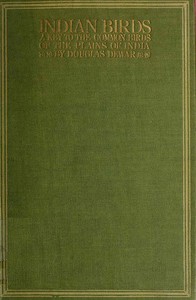
Glimpses of Indian Birds — A Reader’s Guide can be approached with a clearer sense of reading commitment from its source measurements: 79,014 words, 5 hr 44 min estimated reading time, and 10 detected text sections.
The text analysis averages about 20.6 words per sentence, while the detected sections provide another way to judge how the source is divided.
Project Gutenberg metadata also associates the work with “Birds -- India,” connecting these edition facts with the source record’s subject description.
Explore this collection
These alternatives are selected using recorded categories and estimated reading time.
About 343 minutes
Birds
78,665 recorded words. 1 minutes difference from this book's estimate.
View Gutenberg source #3074About 315 minutes
Birds
72,257 recorded words. 29 minutes difference from this book's estimate.
View Gutenberg source #40334About 312 minutes
Birds
71,646 recorded words. 32 minutes difference from this book's estimate.
View Gutenberg source #65440Search stored excerpts and compare books → Choose by your preferences →
Choices use stored catalog measurements. Estimates vary with reading speed. A shared category is a catalog label, not a claim that two books have the same argument or literary quality.
Search reads excerpt text stored with this catalog and links to its associated Gutenberg record. The connection is stored in the site database; this tool does not recheck that every excerpt is word-for-word identical to that external record. Excerpt search does not cover every chapter and does not verify historical publication dates.
Catalog snapshot checked: 2026-09-26. Coverage: 99 public books, 99 available source excerpts.
Calculated from edition completeness, EPUB availability, text structure and catalogue metadata. Not a user rating.
Total of 100 points, scaled to a 2.5-5.0 range. Editions with an empty description or a missing EPUB file are not scored.
Public-domain source text
The source text is kept in the dedicated reader, separate from this catalogue record and its commentary.
Douglas Dewar opens Glimpses of Indian Birds with a direct challenge to the prevailing theories of protective coloration, which he calls a “creed” that has made “authorities” and “schools” the curse of science. Drawing on Huxley, he asserts that nine out of ten birds have some feature that these theories cannot explain. The book is not a systematic field guide but a series of sketches that test hypotheses against what the author sees in the field. Readers should expect a polemical edge: Dewar is as interested in correcting ornithological dogma as in describing birds.
The preface is essential for understanding Dewar’s approach. He attacks “cabinet zoologists” who have elaborated field naturalists’ hypotheses into rigid doctrine. His dedication to Theodore Roosevelt—a hunter and naturalist who “declines to be dictated to by those who have constituted themselves zoological authorities”—signals the combative stance that runs through the book. Dewar claims that reviewers have called his criticisms superficial but have not rebutted them, and he invites them to try. This preface frames the entire work as a corrective to armchair science, urging readers to trust their own eyes over received opinion.
Dewar’s descriptions are grounded in specific details. He notes that the Indian redstart’s “sudden transformation” when it flies reveals a red back that is otherwise hidden. He contrasts the perverse Indian robin, which wears its red patch “on the seat of its trousers,” with the familiar robin of England. On wagtails, he records that the pied wagtail has a black head with a white eyebrow, while the white wagtail has a white face and throat. Such details are not mere identification tips; they are evidence for his argument that coloration often defies adaptive explanations.
Dewar repeatedly gives exact dates for first sightings of migrants—for example, the Indian redstart on September 22, 1906, and September 27, 1907, in Lahore. He urges “bird-lovers of fixed abode in India” to record such dates year after year, calling this a service to ornithology. This emphasis on systematic observation by amateurs reflects his distrust of authoritative pronouncements. The migration accounts also serve his argument: he notes that wagtails feed exclusively on insects, so their migration is “obviously due to the force of habit,” a phrase that quietly challenges more elaborate theories.
Dewar highlights pairs of similar species where one is a permanent resident and the other a migrant, such as the tawny eagle and steppe eagle, or the shikra and sparrow hawk. He reports that a captive steppe eagle died in hot weather while a tawny eagle in the same cage flourished, suggesting real physiological differences. These comparisons are not merely taxonomic; they serve to question why such similar birds have different migratory habits, a puzzle that Dewar leaves for the reader to consider. The excerpts do not reveal his full argument, but the pattern is clear: close observation reveals anomalies that simple theories cannot explain.
Dewar’s book rewards readers who attend to the specific dates, colors, and behaviors he records. The polemical preface may seem dated, but it clarifies why he describes birds the way he does. Rather than seeking a unified theory, the sketches invite you to notice what is there—and to question any explanation that claims too much. The incomplete excerpts leave many of his arguments unfinished, but they offer a clear method: look closely, record precisely, and think independently.
That rainy afternoon, Dewar’s precise plumage notes made me pause—not on the bird, but on the quiet pleasure of doubting what I’d been told. Later, I found myself reaching for A-Birding on a Bronco — Themes and Context, and it felt like continuing the same conversation, unhurried and odd. Some afternoons simply wander into others.
Your answers remain private and are stored only in this browser.