About 65 minutes
Aspects of Reproduction and Development in the Prairie Vole (Microtus ochrogaster) — Text and Context
Insects
14,918 recorded words. 29 minutes difference from this book's estimate.
View Gutenberg source #37450
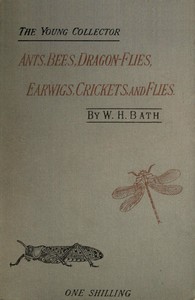
The source record for The Young Collector's Handbook of Ants, Bees, Dragon-flies, Earwigs, Crickets, and Flies (Hymenoptera, Neuroptera, Orthoptera, Hemiptera, Diptera). — Story, Setting & Ideas measures this digital text at 21,580 words, 1 hr 34 min estimated reading time, and 12 detected text sections.
The text analysis averages about 14.7 words per sentence, while the detected sections provide another way to judge how the source is divided.
Project Gutenberg metadata also associates the work with “Insects -- Juvenile literature,” connecting these edition facts with the source record’s subject description.
Explore this collection
These alternatives are selected using recorded categories and estimated reading time.
About 65 minutes
Insects
14,918 recorded words. 29 minutes difference from this book's estimate.
View Gutenberg source #37450About 30 minutes
Insects
6,735 recorded words. 64 minutes difference from this book's estimate.
View Gutenberg source #34412About 172 minutes
Insects
39,457 recorded words. 78 minutes difference from this book's estimate.
View Gutenberg source #44096Search stored excerpts and compare books → Choose by your preferences →
Choices use stored catalog measurements. Estimates vary with reading speed. A shared category is a catalog label, not a claim that two books have the same argument or literary quality.
Search reads excerpt text stored with this catalog and links to its associated Gutenberg record. The connection is stored in the site database; this tool does not recheck that every excerpt is word-for-word identical to that external record. Excerpt search does not cover every chapter and does not verify historical publication dates.
Catalog snapshot checked: 2026-09-26. Coverage: 99 public books, 99 available source excerpts.
Calculated from edition completeness, EPUB availability, text structure and catalogue metadata. Not a user rating.
Total of 100 points, scaled to a 2.5-5.0 range. Editions with an empty description or a missing EPUB file are not scored.
Public-domain source text
The source text is kept in the dedicated reader, separate from this catalogue record and its commentary.
W. Harcourt Bath's handbook opens with a preface that frames insect collecting as a pursuit superior to stamp or coin collecting, because it 'cultivates the observant and intellectual faculties' while providing 'healthful recreation in the fields and woods.' The author addresses his audience as 'most boys' and stresses that the study can be 'prosecuted with very little expense,' making it accessible even to 'the poorest person.' This practical, encouraging tone sets the stage for a guide that assumes no prior entomological knowledge, yet expects the reader to be willing to learn the Latin names and structural details of five insect orders.
The preface does more than justify the hobby; it establishes a philosophy of collecting as a gateway to 'the study and observation of Natural History,' which Bath calls the 'usual fruits' of collecting. He contrasts the finite nature of a stamp collection with the 'practically inexhaustible' field of natural history. This distinction is crucial for a first-time reader: the handbook is not merely a list of species but a tool for developing a scientific habit of mind. Bath also acknowledges his debt to Kirby's illustrated 'Text-Book of Entomology,' signaling that this handbook is a stepping stone to deeper study. The preface thus prepares the reader to approach the subsequent chapters not as a dry catalogue, but as a structured introduction to a lifelong pursuit.
The table of contents reveals a clear progression: after a brief introduction, the book treats five orders in sequence—Hymenoptera, Neuroptera, Orthoptera, Hemiptera, and Diptera. Each order chapter likely follows a consistent pattern, as suggested by the excerpt on Hemiptera. That chapter opens with a general description ('Haustellate insects; they have four wings, which are membranous and naked'), then provides a tabular view of families. For a first reading, these tables serve as a quick reference to the diversity within each order. For example, the Hemiptera table lists fifteen families under two tribes, with common names like 'Shield Bugs,' 'Water Boatmen,' and 'Aphides.' This structure allows the reader to locate a specimen quickly and understand its broader classification without reading the entire chapter.
The excerpt on earwigs (order Euplexoptera, treated within Orthoptera) illustrates Bath's method. He begins with a striking fact: if the mother earwig dies, 'she is immediately devoured by her progeny.' He then discusses distribution, noting that the largest European species 'measures about an inch in length of the body.' The entry includes a common name ('Forficula auricularia') and a figure reference. Most notably, Bath addresses the insect's name: 'The earwig derives its name from its occasionally creeping into the human ear in search of concealment.' He counters skeptics by stating he has 'personally known instances' of this happening, and offers a practical remedy: 'pouring a little oil into the ear.' This blend of natural history, personal testimony, and practical advice is typical of the handbook's approach.
The Hemiptera chapter includes a detailed 'Tabular View of the Principal Families,' which is representative of the book's organizational strategy. For a beginner, this table is more than a list; it is a diagnostic key. Each family is given a common name (e.g., 'Cimicidæ or Bed Bugs') and placed within a sub-order and tribe. The table also indicates the relative rank of groups: for instance, the Heteroptera are 'regarded as the highest of the three groups.' A first-time reader can use this table to quickly identify a bug by its wing type and habitat. The inclusion of families like 'Aphidæ or Aphides' and 'Coccidæ' (scale insects) shows the breadth covered. By cross-referencing the table with the descriptive text, the reader learns to move from general characteristics to specific identification.
Bath's handbook rewards a first reading that moves between the preface's motivational frame, the order-level introductions, and the family tables. Readers are encouraged to start with a familiar insect—perhaps an earwig or a water boatman—and trace its place in the book's structure. The author's direct, occasionally anecdotal style makes the technical content approachable. By treating the tables as a map and the anecdotes as landmarks, a new collector can build confidence in navigating entomological classification without feeling overwhelmed.
The rain kept me indoors with Bath’s handbook, its careful family tables feeling like a quiet porch. Later, I found Insect Adventures — Reading Companion beside it, and the afternoon shifted from sorting dragon-flies to watching their shadows on the page, almost without my noticing.
Answer a few questions and save a private reflection on this device.