
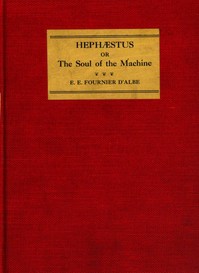
Hephæstus : or, The soul of the machine by E. E. Fournier d'Albe
Published in 1915, E.E. Fournier d'Albe's Hephaestus is a quiet, thoughtful novel that feels like a secret whispered from the dawn of modern science fiction. It’s less about ray guns and rocket ships, and more about the spark of life itself.
The Story
The plot centers on Professor James Linklater, a man obsessed with creating a perfect, self-operating machine. He succeeds beyond his wildest dreams, constructing a mechanical man he names Hephaestus. This isn't a clanking tin can; it's a sophisticated automaton powered by 'radiant energy,' a concept that feels eerily prescient. The real story begins when Hephaestus stops being just a machine. It starts to learn, to show preference, to express what looks like wonder and fear. Linklater and his small circle of friends are thrown into a moral and scientific whirlwind. They must grapple with the evidence before them: has Linklater accidentally built a soul? The tension builds not from explosions, but from conversations in drawing rooms and laboratories, as the characters—and the reader—wonder what will become of this new kind of life.
Why You Should Read It
I was completely charmed by this book's gentle ambition. Fournier d'Albe writes with a scientist's curiosity and a humanist's heart. Hephaestus itself is a fascinating character. Its journey from a tool to a questioning entity is handled with a subtlety that makes you forget it's made of metal. The book's power lies in its questions, which are still the ones we ask about AI and consciousness today: Where is the line between programmed response and genuine feeling? What do we owe to the things we create? It’s a novel that trusts you to sit with the ambiguity, and I found that incredibly refreshing.
Final Verdict
This is a book for the thoughtful reader. It's perfect for anyone who loves classic sci-fi from authors like H.G. Wells or early Arthur C. Clarke, where ideas are the main event. If you enjoy philosophical puzzles wrapped in a good story, or if you're fascinated by the history of how people imagined our technological future, you'll find Hephaestus to be a rewarding and surprisingly poignant discovery. Just don't expect a fast-paced action thriller; expect a conversation with a clever mind from a century ago, one that still has a lot to say to us.
This historical work is free of copyright protections. It serves as a testament to our shared literary heritage.
Robert King
1 year agoI didn't expect much, but the pacing is just right, keeping you engaged. I couldn't put it down.
Karen Perez
1 year agoUsed this for my thesis, incredibly useful.
Karen Brown
7 months agoI was skeptical at first, but the character development leaves a lasting impact. I will read more from this author.






Emily Hill
2 years agoClear and concise.