
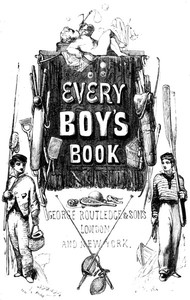
Every Boy's Book: A Complete Encyclopædia of Sports and Amusements by Routledge
Let's be clear from the start: this isn't a novel. Every Boy's Book is exactly what it says on the cover—a giant, sprawling guide. Published in 1864, it tries to be the ultimate manual for a young Victorian gentleman's leisure hours. The anonymous compiler gathered rules for sports, instructions for science experiments, guides to games, and even tips for putting on amateur theatricals.
The Story
There's no traditional narrative. Instead, the 'story' is the journey through hundreds of activities. One page teaches you the official laws of cricket. The next explains how to build a paper balloon that floats. Then it jumps to teaching you card tricks or how to identify different types of clouds. It covers outdoor sports, indoor games, puzzles, and simple chemistry. The book assumes a boy has both the time and the resources to try everything from fishing to putting on a magic lantern show. It's a snapshot of an idealized childhood, one filled with constant, purposeful activity.
Why You Should Read It
I loved this book for its complete sincerity. Today, we might google a game's rules or watch a YouTube tutorial. This book was the Google of its day. The author isn't joking around; they genuinely believe a boy needs to know how to play 'Blind Man's Buff' correctly and that there's a proper way to fly a kite. It's a window into a world without electronics, where entertainment was self-made. You can feel the effort to keep young minds and hands busy. Some advice is timeless (basic first aid), some is wonderfully dated (how to collect butterflies), and some is just bizarre (detailed instructions for games that no one has played in a century). It made me think about how we organize play and what we consider 'worth knowing' for fun.
Final Verdict
This isn't for someone looking for a page-turning story. It's a specialist's dream. Perfect for history buffs, especially those interested in Victorian social life or the history of childhood. Game designers and writers looking for historical inspiration will find a goldmine of odd pastimes. It's also great for anyone with a nostalgic or curious mind who enjoys dipping into old manuals and almanacs. Think of it as a museum exhibit you can browse from your armchair. You won't read it cover-to-cover, but you'll have a smile on your face every time you open it to a random page.
You are viewing a work that belongs to the global public domain. Enjoy reading and sharing without restrictions.
David White
2 months agoI was skeptical about the depth of this book at first, but the visual layout and supporting data make the reading experience very smooth. It definitely lives up to the reputation of the publisher.
Margaret Taylor
6 months agoHaving followed this topic for years, I can say that the nuanced approach to the central theme was better than I expected. A trustworthy resource that I'll keep in my digital library.
Jessica Johnson
10 months agoThe layout of the digital version made it easy to start immediately, the case studies and practical examples provided add immense value. Finally, a source that prioritizes accuracy over hype.
Andrew Hill
1 year agoFast paced, good book.






Jessica Moore
9 months agoHaving explored several resources on this, I find that the way it challenges the status quo is both daring and well-supported. I’ll definitely be revisiting some of these chapters again soon.